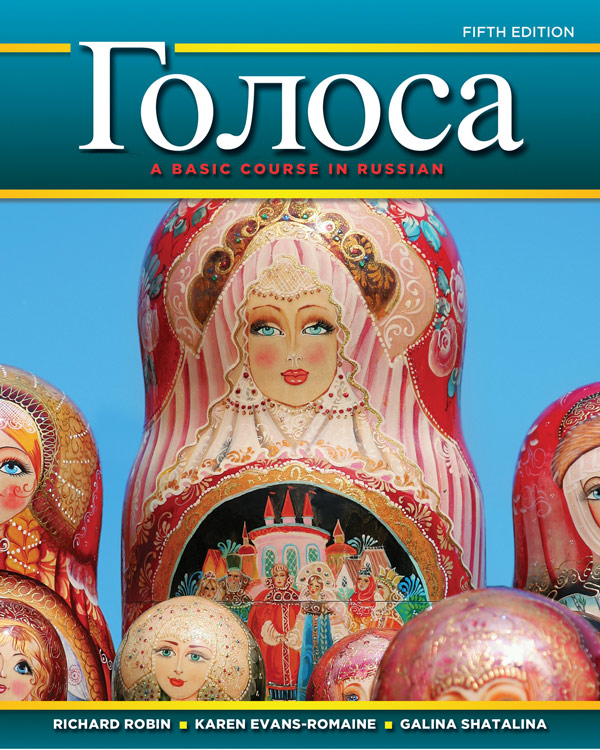

A Basic Course in Russian
5th Edition
|
|
|
MISSING P. 152? In a 2012 reprint of Book 1, p. 152 of the textbook was printed wrong. Download the PDF correction here.
FIFTH EDITION...
From this homepage you can get to...
GOLOSA (Book 1, 5th ed. and Book 2, 4d edition: Richard Robin, Karen Evans-Romaine, Galina Shatalina, and Joanna Robin [Book1]; Pearson Education) is a basic course in Russian. Students successfully completing a course taught in concert with both Books 1 and 2 can expect to reach the ACTFL Intermediate range in speaking and Intermediate High in reading and listening.
Each volume of GOLOSA includes a Main Textbook, and a Student Activities manual (S.A.M.) with laboratory drills, written exercises, and Video activities. The audio program runs approximately 15 hours per volume and includes listening comprehension exercises, speaking dialogues, and rapid-pace oral drills. The video program, available online with exercises in the S.A.M. includes over two hours of interviews with everyday Russians in Russia. Teachers adopting GOLOSA can download the audio from the Golosa website or from MyRussianLab.com. Teachers receive desk copies plus access to the on-line Instructor's Manual with scripts and keys to the audio comprehension exercises.
MAIN FEATURES OF GOLOSA
More information on GOLOSA is available from Pearson, Inc . When ordering examination copies of GOLOSA (either Book 1 or Book 2), make sure that Pearson sends (a) the Textbook and (b) the S.A.M. (which contains most of the homework assignments).
How much time for GOLOSA? Below we suggest a schedule for GOLOSA based on 10 hours per unit. Under normal circumstances, one can cover nearly everything in each volume of GOLOSA in two years, assuming a two-semester year at four to five hours per week. With room for tests, finals, and time lost to administrative tasks, that comes to about 200 hours of contact instruction.
SCHEDULE FOR A TYPICAL GOLOSA LESSON: 10 HOURS
|
Do this in class |
Assign this for next time | |
|
Hour 1 | ||
|
Quiz previous unit Introduce essential lexical items for the next unit as presented in О чём идёт речь. |
Before the next class go to lab. Listen to Разговоры in О чём идёт речь. Complete questions in the exercises in the Main Textbook. | |
|
Hour 2 | ||
|
Check students answers to questions in the exercises on О чём идёт речь. Break down Диалоги. |
Memorize one of the Диалоги. Be prepared to read the remaining dialogues in class out loud with stress, vowel proper reduction, and intonation. | |
|
Hour 3 | ||
|
Students perform the Диалоги. Do the lexical exercises following the Диалоги plus Подготовка к разговору. Explain 1-2 grammatical points. Use first few Устные упражнения in the S.A.M. to illustrate. |
Read explanations of grammar that was covered inclass. Assign 2-3 grammar exercises (Письменные упражнения) covering points explained in class (S.A.M.). In lab do the appropriate Устные упражнения (S.A.M.). | |
|
Hour 4 | ||
|
Review assigned Устные упражнения (S.A.M.). Explain 1-2 more grammar points. Use appropriate Устные упражнения from the S.A.M. to illustrate. |
Assign 1-3 Игровые ситуации and Устный перевод . Complete appropriate Устные упражнения (S.A.M.) in the language lab. | |
|
Hour 5 | ||
|
Review Устные упражнения (S.A.M.). Turn them into mini-situations: single-answer responses. Students perform Игровые ситуации.
|
Students write out more grammar exercises (Письменные упражнения) in S.A.M. Assign exercises on Числительные, Фонетика и интонация. | |
|
Hour 6 | ||
|
Review Устные упражнения, Turn them into mini-situations: single-answer responses. Review Числительные, Фонетика и интонация. |
Assign more Игровые ситуации. | |
|
Hour 7 | ||
|
Review any remaining Игровые ситуации. Finish any uncovered grammar. Use remaining Устные упражнения in the S.A.M. to illustrate.
|
Assign appropriate Устные упражнения for the Lab as well as appropriate grammar exercises from the S.A.M. | |
|
Hour 8 | ||
|
Review any remaining Устные упражнения. Turn them into mini-situations: single-answer responses. Review any undone Игровые ситуации. |
Assign Давайте почитаем and/or Обзорные упражнения. | |
|
Hour 9 | ||
|
Review reading activities
|
Assign listening exercises (Давайте послушаем, Main Textbook) and/or Видео (S.A.M.) | |
|
Hour 10 | ||
|
Review listening activities (and/or Видео). |
Quiz for next day. | |