
Events — 2007
Research Professor Henry Hertzfeld Interviewed on Wall Street Journal Law Blog
A letter from Research Professor Henry Hertzfeld commenting on space law education was published in the October 18, 2007 print edition of The Wall Street Journal. The letter led to Professor Hertzfeld being interviewed for the Journal's law blog.
Space Policy Institute a Large Presence at the 58th International Astronautical Congress, Hyderabad, India
Law School Team Wins Moot Court Competition
Among the almost 2,000 space leaders from government and industry who gathered in Hyderabad, India on September 24-28 for the leading annual international space meeting were all three faculty members of the Elliott School's Space Policy Institute - Director John Logsdon and Professors Ray Williamson and Henry Hertzfeld . They were joined by two recent Elliott School graduates, Audrey Schaffer and Ian Christensen, and three current students, Jason Hay, Emma Hinds, and Angela Peura. All five students concentrated their graduate studies on space policy issues. Logsdon and Williamson presented papers at the Congress. Hertzfeld coached a team of GW Law School students (David Western and Magin Puig) in the Manfred Lachs International Space Law Moot Court Competition to victories over opponents from Europe and Australia. Hinds represented GW at a meeting of the Space Generation Advisory Council in the days just preceding the Congress. Schaffer and Christensen presented separate papers, and Hay and Puera combined for a joint presentation. Travel support was provided for Hinds, Hay, Christensen, and Peura by the U.S.-India Science and Technology Foundation, and for Schaffer, Western, and Puig by NASA.

(from left to right) Ian Christensen, Emma Hinds, Angela Peura

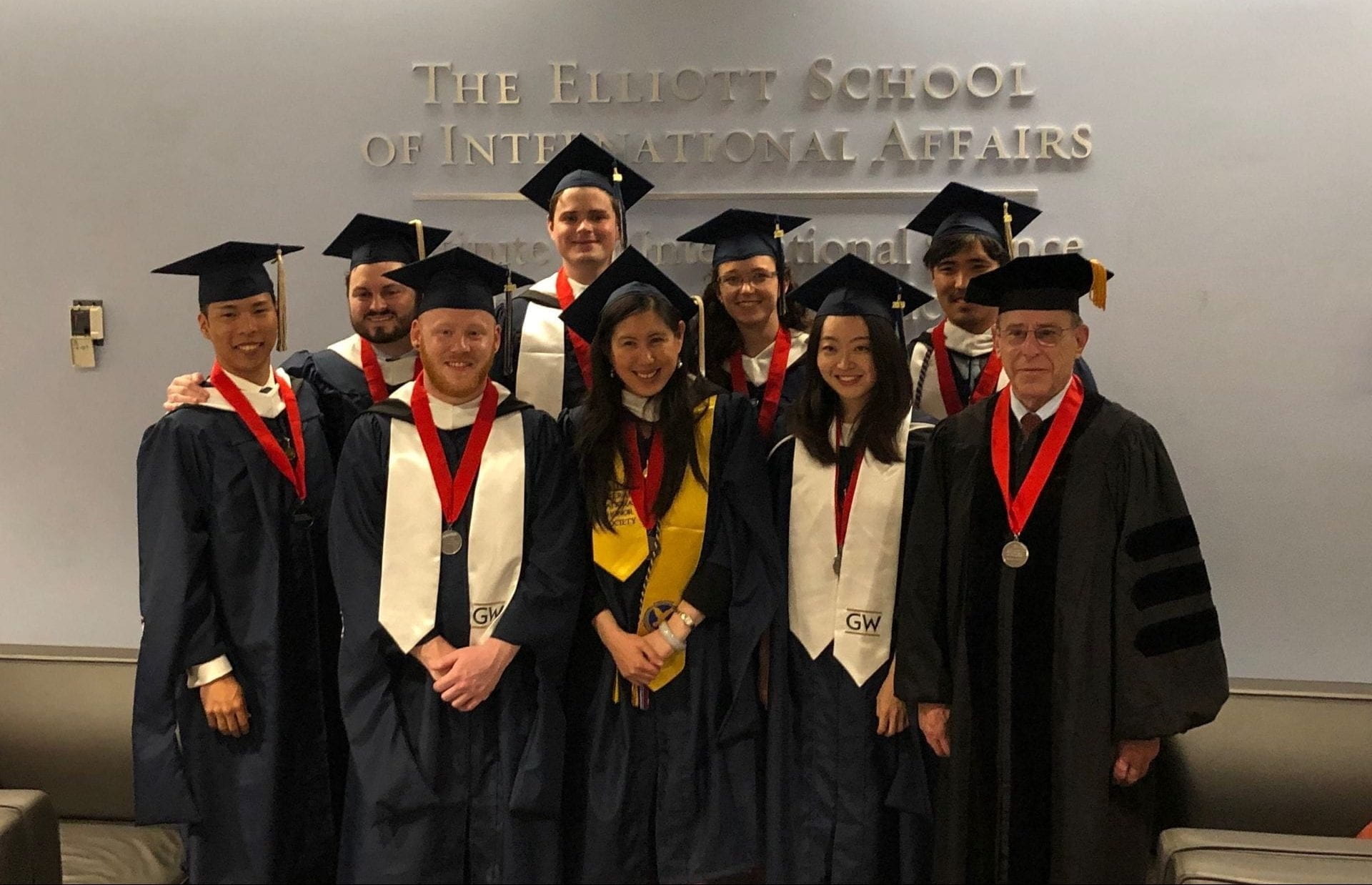
(from left to right) David J. Western, Magin Puig-Monsen, and
Henry R. Hertzfeld, Faculty Advisor
On Saturday, March 31, 2007 the GW team won the North American Competition in the Manfred Lachs International Space Law Moot Court Competition. GWU competed against 8 other schools from the U.S. and Canada; the competition was held in Washington at the Georgetown Univ. Law School. GWU won all of the awards: best oralist (David J. Western), best team brief, and best team.
The GWU team then competed in the last week of September for the world title against the winner of the European competition, Leiden University of the Netherlands, and the winner of the Asia/Pacific competition, Singapore University, in Hyderabad, India. This competition was sponsored by the International Institute of Space Law. and the competition was held in conjunction with the annual International Astronautical Federation Congress. Arguing before three judges from the International Court of Justice, The Hague, Netherlands, the GW team was declared the global winner in this year's competition.
Remote Sensing Applications to Natural Hazards
September 12, 2007
Sponsored by: The Space Policy Institute, the MCEER Remote Sensing Institute, and Imaging Notes magazine.
Presentation Slides:
Remote Sensing Tools for Resilient Hurricane Response and Recovery
by Dr. Beverly Adams, ImageCat Ltd
Remote Sensing Applications to Natural Hazards: Future Research, Development, and Application Needs
by Philip Ardanuy, Raytheon Information Solutions
Resilience, Multi-Hazard Engineering, MCEER, and the MCEER Remote Sensing Institute
by Michel Bruneau, MCEER, University at Buffalo
A tiered reconnaissance approach toward flood monitoring utilising multi-source radar and optical data
by Benjamin Oates, Dr Jeremy Morley, University College London
Recent Research in Monitoring earthquakes by using multisenssor satellite and ground data
by Dimitar Ouzounov
Using remote Sensing in the long term recovery and restoration in New Orleans
by John C. Pine, Louisiana State University
Challenges of Monitoring & Managing the response to Volcanic Activity
by Chris S. Renschler, University at Buffalo, SUNY, NY
International Charter Space and Major Disasters
by Barbara J. Ryan, U.S Geological Survey
U.S Approaches to A Comprehensive Earth Observation Strategy
by Dr Gene Whitney, Office of Science and Technology Policy, Executive office of the President
Fourth Earth Observation Ministerial Summit November 30, 2007
by Gregory W. Withee, USGEO Task Group Co-Chair
Remote Sensing Tools for Earthquake Response and Recovery
by Fumio Yamazaki, Chiba University, Japan and Masashi Matsuoka, National Institute of Advanced Industrial Science and Technology, Japan
5th International Workshop on Remote Sensing Applications to Natural Hazards
Sept 10-11, 2007
The Space Policy Institute, the MCEER Remote Sensing Institute, and Imaging Notes magazine presents a Workshop on 'Remote Sensing Applications to Natural Hazards.'
To see Workshop Resolutions, click here.
SAR Remote Sensing for Urban Damage Assessment for Tehran Presentation Paper by Babak Mansouri, IIES, Masanobu Shinozuka, UCI, and Reza Nourjou, IIEES
Damage Assessment on buildings using very high resolution multimodal images and GIS Presentation Paper
by Anne-Lise CHESNEL, Renaud BINET and Lucien WALD, France
Social Vulnerability assessment using satellite data Presentation Paper
by Annemarie Ebert, Norman Kerle and Alfred Stein, International Institute for Geo-Information Science and Earth Observation
Damage detection at different scales from SAR and QuickBird imagery for the 2003 Boumerdes, Algeria, earthquake Presentation Paper
by G. Trianni, F. Dell'Acqua, P. Gamba, University of Pavia
Developing fragility functions for tsunami damage estimation using the numerical model and satellite imagery. Presentation Paper
by Shunichi KOSHIMURA, Hideaki YANAGISAWA, Tohoku University
Overview and Current State of the 'GEO (Global Earth Observation) Grid Presentation Paper
by Masashi Matsuoka, S. Kodama, R. Nakamura, N. Yamamoto, H. Yamamoto, K. Iwao, S, Tsuchida and S. Sekiguchi, AIST, Japan
Charecteristics of Remote Sensing Image and Digital Elevation Model at Different Site Geomorphology Presentation Paper by Saburoh MIDORIKAWA, Kazunori ISHII, Hiroyuki MIURA, Tokyo Institute of Technology
Detection of Building Damage due to the 2006 Central Java, Indonesia Earthquake Using Satellite Optical Images Presentation Paper
by Hiroyuki Miura (CUEE) and Saburoh Midorikawa, Tokyo Tech
Virtual Chi-Chi on Digital Earth Model as Post-Earthquake Recovery Digital Archive Presentation Paper
by Osamu Murao, Atsushi Miyamoto, Takayuki Sasaki, Japan
Learning new methodologies to deal with large disasters: Multisensor approach of analyzing atmospheric signals and search for possible earthquake precursors. Presentation Paper
by D. Ouzounov, S. Habib, F. Policeli, P. Taylor
Katrina/RITA Clearinghouse Cooperative Presentation Paper
by John C. Pine, Louisiana State University
Application of Statistical Inferencing Techniques to Building Inventory Compilation Presentation Paper
by Pooya Sarabandi, Anne S. Kiremidjian, Stanford University and Ronald T. Eguchi, ImageCat Inc
An Evaluation of Earthquake Damage Scales used in Remote Sensing Studies Presentation Paper
by Ellen M. Rathje, University of Texas at Austin and Beverley Adams, ImageCat Inc.
Linking a Collaborative Platform and Multi-hazard Models to Support the Integrated Management of Extreme Events Presentation Paper
by Chris S. Renschler, Sue Roussie and Martin Minkowski, Center for GeoHazards Studies
Flash Flood Event Assessment (FFEA): Terrestrial and Satellite Remote Sensing for Flash Flood Assessment Presentation Paper
by Richard P. Watson, HydroBio Inc. and Theresa R. Watson, Catamount LLC
Remote-Sensing Assessment of Wind Damage Presentation Paper
by J. Arn Womble, Texas Tech University, Beverley J. Adams, ImageCat Inc, Kishor C. Mehta, Texas Tech University
Speed Detection for Moving Objects from Digital Aerial Camera and QuickBird Sensors Presentation Paper by Fumio Yamazaki, Wen Liu, Chiba University, Japan and T. Thuy Vu, National Institute of Advanced Industrial Science and Technology, Tsukuba, Japan.
From Buncefield to Tunguska: Hazard and Disaster Modelling at the University of Southampton Paper by N.J. Bailey, J.S. Bevington, H.G. Lewis, G.G. Swinerd, P.M. Atkinson, R. Crowther, D. Holland
Results of Neighborhood Level Analysis of Structural Storm Surge Damage to Residential Structures Paper
by Carol J. Friedland, Beverley J. Adams, and Marc L. Levitan
Linking a Collaborative Platform and Multi-hazard Models to Support the Integrated Management of Extreme Events Paper
by Chris S. Renschler, Suzanne Roussie, and Martin Minkowski
A tiered reconnaissance approach towards flood monitoring, utilizing multi-source radar and optical imagery Paper by A. Mcmillan, B. J. Adams, J. G. Morley, S. Chesworth
Workshop Objectives
Workshop Program
Group A discussion summary
Group B discussion summary
Proceedings Cover
Order of papers in Notebook
Workshop Exercise
Collective Security in Space: Asian Perspectives on Acceptable Approaches
On April 23-24, almost 50 space analysts, industry representatives, and government officials from Japan, South Korea, China, India, Malaysia, Australia and the United States met in Tokyo to discuss their varying perspectives on how best to make space access and use secure for all who would use the space environment for peaceful purposes. This workshop was part of the Space Policy Institute's "Collective Security in Space" project. The project's goal is to broaden the global community of analysts and government officials discussing various suggestions on the best ways to assure space security, with the end result being an increasing consensus on which approaches are toward achieving a space environment free of threats to peaceful uses of space. The Tokyo workshop was co-sponsored by the Center for Non-Proliferation of the Monterey Institute of International Studies and the Tokyo-based Research Institute for Peace and Security. Financial support for the "Collective Security in Space" project was provided by the John D. and Catherine T. MacArthur Foundation. The Secure World Foundation also sent several representatives to the workshop. Workshop papers will be published later this year.
To see the workshop program, click here.
To see a report on the workshop, click here.
Individual Presentations are below:
"Collective Security in Space: Asian Perspectives," Yoichi Kamiyama, Mitsubishi Corporation
"Current Capabilities for Space Security: A Korean Perspective," Changdon Kee, Seoul National University
"To Develop Space Peacefully for Benefits of Human Beings," Yang Junhua, Chinese Society of Astronautics
"Indian Space Programme & Some Reflections On Collective Security In Space," Rajeev Lochan, Indian Space Research Organization
"Space Security of Asia from the Perspective of International Space Law," Setsuko Aoki, University of Keio
"China and Space Security," Zhong Jing, National Defense University, PLA
"Perspectives on Space Security: Assessing the Situation and Exploring the Options," Kiran Nair, Centre for Airpower Studies
"Collective Security in Space: An Australian Perspective," Brett Biddington, Asia Pacific Defense and Space Group, CISCO
"U.S. Perspectives On Space Security," Joan Johnson-Freese, Naval War College
"Chinese Role in the Regional Space Security Cooperation and APSCO," Yang Mingjie, China Institutes for Contemporary International Relations
"Indian Perspectives On Regional Space Security," Dipankar Banerjee, Institute of Peace and Conflict Studies
"Japanese Steps towards Regional and Global Confidence Building," Kazuto Suzuki, University of Tsukuba
"The Role of the United Nations In Space Security," Mazlan Othman, Malaysian National Space Agency (ANGKASA)
The Contribution of Satellite Data to Efficient Freshwater Management
March 13, 14 2007
- Workshop Agenda
- Workshop Report
- Summary Chart: "Earth Observation Data for Different Economic Applications: Applicability of Satellite Data"
Presentations:
The Space Policy Institute Study-Ray Williamson
The US Stream Gauge Network-Steve Blanchard, USGS Office of Surface Water
NOAA's Water Resource Information-Chandra Kondragunta, NOAA NESDIS
NRCS's Water Resource Information Systems-Claudia Hoeft, National Climate and Water Center, NRCS
NASA's Satellite Water Information Research-Jared Entin, NASA Earth Sciences
Data Assimilation and Modeling-Paul Houser, CREW & George Mason Univ.
Economic and Cultural Issues in Valuing Water-Henry Hertzfeld, Space Policy Institute
Measuring Benefits of Water Resources Information-Laurie Houston, Consultant
Institutional Issues-Katharine Jacobs, University of Arizona
Economic and Policy Issues - Molly Macauley, Resources for the Future
"NOAA's Satellite Data and Information" - Gerry Dittberner, NOAA- NESDIS
News
GWU Faculty Honored at AIAA Awards Gala
SPI Professor Emeritus John Logsdon Writes Feature Article in Quest
SPI Director Scott Pace Gives Ohio State Universite Lecture on 'Frontiers of Innovation in Human Space Flight'
SPI Director Scott Pace Discusses the Future of US Space Policy at CFR Live Meeting
SPI Visiting Scholar Speaks at JAXA Washington Office
SPI Director Scott Pace Writes Guest Blog for The Diplomat
George Washington University Team Competes in Quarter Finals of 2013 North American Space Law Moot Court Competition
SPI Alumna to Moderate NASA's First Spanish Language Google+ Hangout
C-SPAN, SpacePolicyOnline, The Space Review and Aviation Week cover SPI-AIAA Event, "Columbia+10: Lessons Learned and Unlearned"
SPI Professor Henry Hertzfeld interviewed on The Space Show
Papers by SPI Faculty named in Science Direct's Top 25 Hottest Articles from Advances in Space Research for 2012
SPI Director Scott Pace cited by Der Spiegel
SPI Students Discuss Space Policy
Space Policy Institute and Secure World Foundation Release 'A Guide to Space Law Terms'
SPI Professor Emeritus John Logsdon speaks in panel on the need for a definitive U.S. space policy
SPI Director Scott Pace testifies before the House Committee on Science, Space and Technology
SPI Hosts Workshop on "Developing a Responsible Environmental Regime for Celestial Bodies"
SPI Professor Emeritus John Logsdon discusses the possibility of a new direction in space exploration in the second term of the Obama Administration
SPI Professor Pascale Ehrenfreund named to the National Research Council Committee on Human Spaceflight
SPI Director Scott Pace weighs in on the space policies of the Presidential candidates in Space News
SPI student and faculty present at 63rd International Astronautical Conference in Naples, Italy
SPI Director Scott Pace interviewed on Russian television news program
SPI Director Scott Pace and SPI Associate Professor Kris Lehnhardt participated in the Deep Space: Relaunching American Exceptionalism discussion on the Hill
SPI Director Scott Pace featured at the 2012 Spectrum Management Conference
SPI Director Scott Pace featured at the Washington Space Business Roundtable lunch
SPI Visiting Scholar Chris Gilbert published in Space News
SPI Professor Henry Hertzfeld interviewed on WUSA9
SPI Director Scott Pace published on 38North.org
SPI Director Scott Pace published in the Harvard International Review
SPI Professor Emeritus John Logsdon traces the earlier "survival crisis" of the planetary program
SPI Graduates Laura Delgado and Megan Ansdell are published in Space Policy
SPI Director Scott Pace interviewed on the Kojo Nnamdi Show
SPI Director Scott Pace provided testimony to the House Subcommittee on Aviation
SPI Professor Pascale Ehrenfreund published in Advances in Space Research
SPI Director Scott Pace writes a guest blog for Space News
2011 SPI Graduate Laura Delgado-Lopez interviewed on Mainstream Media Project
SPI Director Scott Pace published in Space News
SPI Professor Pascale Ehrenfreund published in Astrobiology Journal
SPI Director Scott Pace moderated the AIAA Plenary Session: NASA Science Missions in the Next Decade
Contact Us
Phone: 202.994.7292
Fax: 202.994.1639
Email: spi@gwu.edu
Address:
Space Policy Institute
1957 E Street, N.W., Suite 403
Washington, D.C. 20052