Recent newspaper stories about the debate over whether to develop
"mini-nuke" "bunker-busters" and the implications
of new weapons for the current nuclear test moratorium (Note
1) is reminiscent of the pressure put on the Eisenhower and
Kennedy administrations to end a moratorium on nuclear weapons
tests to allow testing of low-yield tactical nuclear weapons.
Pressures for nuclear testing on both sides of the Cold War line
ended the moratorium and shaped the Limited Test Ban Treaty which
the U.S. government, the United Kingdom, and the Soviet Union
signed forty years ago this week on 5 August 1963. Negotiated
after years of effort to finalize a comprehensive test ban, the
LTBT addressed the problem of fallout from nuclear tests by banning
tests in the atmosphere, underwater, and in outer-space. (Note
2)
A significant event in both Cold War history and the history
of nuclear policy, the treaty eased global anxiety over fallout
from nuclear tests but it also suggested the possibility of a
new era in US and Soviet relations. At the same time, the treaty
deepened the split between the Soviet Union and China, which was
determined to test nuclear weapons despite the treaty. While France
and China would ignore the LTBT and test weapons in the atmosphere
for years to come, the treaty was a significant international
public health success by eliminating the atmospheric testing of
the nuclear superpowers. Nevertheless, the limited test ban signified
a deeper failure to negotiate the comprehensive test ban that
proponents saw as important for curbing nuclear proliferation
and checking the U.S.-Soviet arms competition. Indeed, the LTBT
facilitated superpower nuclear arms development by making underground
nuclear tests a routine event. Forty years later, diplomats have
negotiated a comprehensive test ban treaty (CTBT) that bars all
nuclear weapons tests, but the United States and other major powers
have yet to ratify it.
This electronic briefing book begins with an overview of the
unsuccessful attempt between 1958 and 1963 to negotiate a comprehensive
nuclear test ban and the political dilemmas that forced London,
Moscow, and Washington to negotiate a limited treaty. A selection
of sixty-five declassified U.S. government documents on the treaty
negotiations follows; most of them are published here for the
first time. The documents illustrate the concerns that drove the
U.S. negotiating position--world public opinion, pressure from
allies, the status of the Soviet nuclear weapons program, and
concern about the proliferation of nuclear capabilities. The documents
also illustrate the major controversies over verifying nuclear
test ban treaties, especially U.S. and British pressures for an
international inspection system. (Note 3)
The Test
Ban and Politics, 1955-1960
The Kennedy Administration holds the distinction of signing off
on the first test ban treaty, but the concept of an agreement
prohibiting nuclear tests emerged during the mid-1950s, when Dwight
D. Eisenhower was U.S. President and Nikita Khrushchev was consolidating
his leadership position in the Soviet Union. Through 1958, both
superpowers routinely held atmospheric nuclear tests; between
1953 and 1958, the United States and the Soviet Union, along with
the United Kingdom, held a total of 231 atmospheric tests. (Note
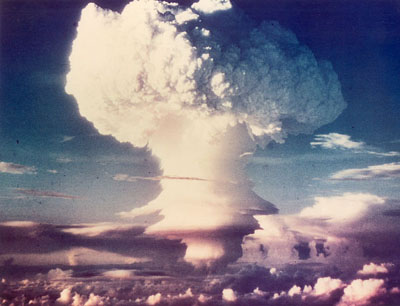
4) These tests, some of which were of massive proportions,
increased global public apprehension over atomic weapons, especially
the dangers of radioactive fallout. The danger of fallout exposure
received wide publicity as Hiroshima victims ("the Hiroshima
Maidens") visited the United States for treatment. Especially
prominent was the case of the Japanese fishing ship Lucky Dragon
whose crew encountered fallout produced by the fifteen megaton
"Bravo" shot on 28 February 1954--an explosion whose
explosive yield was the equivalent of 1,000 Hiroshima bombs. Radiation
exposure certainly played a role in the death of one crew member.
(Note 5)
Denying that atmospheric testing caused adverse health effects,
the Atomic Energy Commission went on the attack against critics.
But the AEC's own internal studies raised questions about fallout
contamination, especially the impact of strontium-90 (radiostrontium)
on the food supply. During the 1960s, AEC scientists and advisers
would look closely at the impact of radioiodine on the thyroid.
Although debate about the impact of low doses of radioactivity
continues, a study completed in 2001 by the National Cancer Institute-Center
for Disease Control tentatively concluded that exposure to fallout
from nuclear tests during the 1950s was associated with an increase
in U.S. cancer mortalities; fallout exposure may have caused more
than 11,000 deaths. (Note 6)
Growing concern over fallout fostered politically influential
antinuclear activism around the world. Adlai Stevenson, the Democratic
Party's presidential candidate in 1952 and 1956, took strong positions
in favor of a test ban. (Note 7) Dwight D. Eisenhower
was personally interested in halting nuclear tests but his administration
was divided. Top advisors, such as Atomic Energy Commission Chairman
Lewis Strauss fervently supported testing and downplayed the fallout
problem. Strauss along with senior Pentagon officials agreed that
testing was necessary to maintain the U.S.'s superiority over
the Soviets in nuclear weapons technology. (Note
8) Secretary of State John Foster Dulles, along with Eisenhower
himself, realized that a moratorium on nuclear testing leading
to a comprehensive ban test ban would improve the US's image.
During a May 1954 National Security Council meeting, the 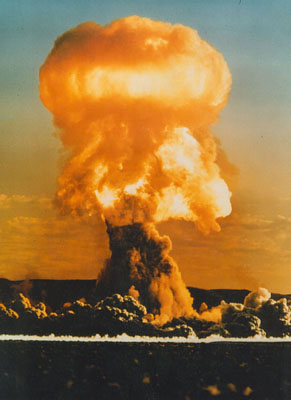 president
stated "We could put [the Russians] on the spot if we accepted
a moratorium. . . Everybody seems to think that we're skunks,
saber-rattlers and warmongers. We ought not miss any chance to
make clear our peaceful objectives." (Note 9)
Nevertheless, Eisenhower was reluctant to oppose the AEC and the
issue was stalemated.
president
stated "We could put [the Russians] on the spot if we accepted
a moratorium. . . Everybody seems to think that we're skunks,
saber-rattlers and warmongers. We ought not miss any chance to
make clear our peaceful objectives." (Note 9)
Nevertheless, Eisenhower was reluctant to oppose the AEC and the
issue was stalemated.
The dynamics of the test ban issue changed in significant ways
during 1958. Eisenhower's prestigious President's Science Advisory
Committee (PSAC), upgraded in the wake of the Sputnik crisis
developed significant arguments on the merits of test limitations
and the possibilities of verifying a test ban. The Soviets, who
had been calling for a test ban since the mid-1950s, took a major
initiative in early 1958 when they called for an American-British-Soviet
test moratorium. At the end of March, the Soviets announced that
they were unilaterally halting nuclear tests. This put Washington
under great political pressure. As a first step, before making
any decisions on a moratorium, Eisenhower and British Prime Minister
Harold Macmillan reached an agreement with Khrushchev to sponsor
an international conference of scientific experts to discuss the
problem of monitoring and verifying a test ban. This was a key
issue because detecting nuclear tests, especially underground
detonations, involved so many complex scientific and technical
problems. (Note 10)
The Conference of Experts met in Geneva during the summer of
1958 and closely studied the major methods for detecting nuclear
tests: air sampling, acoustics, seismic, and electromagnetic.
University of California physicist (and winner of the 1939 Nobel
Prize) Ernest Lawrence led the U.S. delegation. Despite some U.S.-Soviet
disagreements over the feasibility of telling apart underground
tests and earthquakes, Cold War rifts did not prevent the participants
from producing a report. The experts concluded that a network
of 170 control posts in and around Eurasia and North America would
be able to detect atmospheric tests down to one kiloton and 90
percent of underground tests down to five kilotons. Where the
report was ambiguous was who would work at the posts and how the
international organization that oversaw verification would decide
whether an on-site inspection was necessary to confirm whether
an illegal nuclear test had occurred. (Note 11)
Despite some ambiguities, the Geneva report was positive enough
to facilitate a U.S. decision to participate in a moratorium.
On 22 August 1958, the day after the experts had finished their
report, Eisenhower announced that the United States would halt
nuclear testing for one year if the Soviet Union (and the United
Kingdom) would do likewise. To determine whether they would make
the moratorium permanent, the three powers agreed to begin test
ban negotiations in Geneva on 31 October. All three countries
had last-minute nuclear tests during September and October. (Note
12)
The Geneva test ban negotiations, which lasted from late 1958
through early 1962, were difficult and protracted largely because
of continued controversy over the requirements of verification.
The United States consistently pushed for on-site verification
to ascertain whether a questionable event was an earthquake or
a nuclear test. Some of the pressure was based on a firm belief
that remote instrumentation was not, in itself, sufficient to
conclude whether a suspicious event was a test or not. Significantly
influencing U.S. policy thinking about inspection was the conviction
that it was a way to open up Soviet society to "qualified
observers", as Eisenhower put it in early 1959.
The Soviets insisted on what amounted to a veto over on-site
inspections by the control commission with the control posts to
be staffed mainly by the host country. While the Soviets eventually
dropped the veto requirement, another complicating element was
new U.S. information suggesting (erroneously as it turned out)
that the Geneva experts report had significantly understated the
difficulty of differentiating between underground tests and earthquakes.
Critics of the moratorium developed elaborate theories on how
a test ban could be evaded while the Pentagon constantly pressed
for a resumption of testing. Senior officials such as Christian
Herter (who succeeded Dulles as Secretary of State) were willing
to settle for an "imperfect" system on the grounds that
it would provide enough incentives to discourage cheating, but
conservative Republicans in the Senate insisted on an ironclad
system. (Note 13)
Various efforts to break the stalemate failed and disagreements
increased in late 1959 when the U.S. and the British tried to
prompt a discussion of the problem of seismic detection in the
light of the new data. Nevertheless, differences narrowed during
the spring of 1960. The negotiators reached an agreement on a
threshold test ban that would forbid atmospheric, outer-space,
and underwater tests, except for small underground tests, on which
a moratorium would be placed. At that point, the three powers
would have to resolve two issues at the highest level: the number
of inspections in each country and how long the moratorium would
last. (Note 14) The possibility that an agreement
would be reached at the Paris Summit in May 1960 disappeared,
however, in the wake of the shoot-down of a U.S. U-2 reconnaissance
plane flying over Soviet territory on 1 May 1960. While the talks
at Geneva continued, disagreements over verification were not
likely to be overcome in the harsh post-U-2 crisis environment.
Kennedy
and the Test Ban
The administration of John F. Kennedy would continue the test
ban negotiations, but with even greater pressures to resume testing.
Like Eisenhower, Kennedy had to face pressure from the Pentagon
and the nuclear weapons laboratories, on the one hand, and international
political pressure favoring a test ban on the other hand. Khrushchev
was also under pressure from the Soviet military to break the
moratorium and he made the first move on 1 September 1961. The
moratorium collapsed during an unfolding U.S.-Soviet crisis over
the status of West Berlin and the resumption of testing contributed
to the tensions. Kennedy followed with underground testing in
mid-September 1961, but delayed atmospheric testing until the
spring of 1962. Both sides tested more than 200 weapons during
1961 and 1962. (Note 15)
Besides his interest in meeting international opposition to testing,
and political pressure from such Democratic influentials as Senator
Hubert Humphrey (Mn), one of Kennedy's central motives in seeking
a test ban treaty was to check the proliferation of nuclear weapons.
In 1961, only four nations, the U.S., USSR, United Kingdom and
France, had tested nuclear weapons. Other countries such as China
and Israel were on the verge of attaining independent nuclear
capabilities. Kennedy and his advisers, including prominently
Secretary of Defense Robert McNamara, worried that the global
 proliferation
of nuclear capabilities would make the world far more dangerous.
Thus, during a 21 March 1963 news conference, Kennedy expressed
his concern when he said, "I see the possibility in the 1970's.
. . [of] the United States having to face a world in which 15
or 20 or 25 nations may have these [nuclear] weapons. I regard
that as the greatest possible danger and hazard." With a
comprehensive test ban in place, however, would-be proliferants
would face greater international pressures not to test and the
possibility of detection could deter cheating. (Note
16)
proliferation
of nuclear capabilities would make the world far more dangerous.
Thus, during a 21 March 1963 news conference, Kennedy expressed
his concern when he said, "I see the possibility in the 1970's.
. . [of] the United States having to face a world in which 15
or 20 or 25 nations may have these [nuclear] weapons. I regard
that as the greatest possible danger and hazard." With a
comprehensive test ban in place, however, would-be proliferants
would face greater international pressures not to test and the
possibility of detection could deter cheating. (Note
16)
Among the would-be nuclear powers that concerned the Kennedy
administration, China's nuclear ambitions were the source of great
apprehension and a central consideration in Kennedy's drive for
a test ban. Mao Zedong and the Chinese leadership had decided
to push forward on nuclear weapons development during the mid-1950s,
soon after a confrontation with the U.S. over Taiwan. Washington's
stance was that the potential threat to global stability posed
by a nuclear China necessitated a test ban agreement. Kennedy
and his advisors believed that a nuclear-armed China would pose
a serious threat to U.S. national security and win greater influence
in Asia, limiting U.S. influence in the region. (Note
17)
Senior Kennedy administration officials considered options to
prevent the Chinese from obtaining nuclear weapons, including
possible military action. They agreed that the best course of
action for curbing China's nuclear project, or at least isolating
Beijing from the rest of the world, was to sign a test ban treaty
with the Soviet Union. Such a treaty would raise international
pressure on China, and other countries, to halt their efforts
to arm themselves with nuclear weapons. If there was a treaty
in place and the Chinese still did not halt their weapons program,
Kennedy and his advisors considered the possibility of a joint
United States and Russian understanding on military action against
China. (Note 18)
Kennedy's staff reasoned that such a deal was possible with the
Russians because they, like the US, had to be aware that China's
weapons could just as easily strike Russia as they could the United
States. CIA official Sherman Kent pointed out that the USSR would
be loathe to see atomic weapons in China because in the event
that China took aggressive action against a U.S. ally in East
Asia, the Soviets would have to make a decision: "Whether
to stand by and see China . . . knocked into a cocked hat [by
the United States], or whether to come to China's defense. . ."
(Note 19) The latter course of action could
force the Soviet Union into an unwanted nuclear war with the United
States.
The Soviets too, had their own fears of proliferation, which
contributed to their interest in a test ban. Soviet concern centered
on the possibility of an independent West German nuclear capability
as well as the U.S. proposal to establish a Multilateral Force
(MLF), which would involve continental Western European allies
in a sea-based nuclear force. While the Kennedy administration
saw the MLF as a way to check any West German nuclear aspirations,
the Soviets continued to view the MLF with alarm. During discussions
and negotiations between the two nations, those issues arose repeatedly.
When meeting with Soviet Ambassador Anatoliy Dobrynin in August
1962, U.S. Secretary of State Dean Rusk noted that while the U.S.
and the Soviets differed in opinion on which countries would be
more of a threat with nuclear armaments, "surely we could
agree that [the U.S. and Soviet Union] would both be better off
if none of them developed nuclear weapons." (Note
20)
Some U.S. intelligence officials were not so confident that Russia
could influence the PRC decision to proceed with their weapons
program. For example, in October 1962, CIA Deputy Director of
Intelligence Ray S. Cline observed that China would continue with
its plans, and that the Soviets were not likely to obtain "the
leverage to produce a change in this decision." (Note
21)
Whatever impact a treaty would have on China, the Kennedy and
Macmillan continued to negotiate with the Soviets. Pressures from
the Joint Chiefs to continue testing indefinitely complicated
the U.S. position and the verification problem remained a critically
important obstacle to agreement. During the early 1960s, a quota
of 20 inspections annually was the standard figure in U.S. discussions,
based on the idea of a sampling 20 percent of unidentified seismic
events in Soviet territory. The Soviets, however, would only accept
limited numbers of inspections--three was the usual figure--but
in late 1961 they reversed course insisting on reliance on national
means of verification. By the end of 1962, however, Khrushchev
showed some give suggesting that he was open to 2 or 3 inspections.
While the administration had treated 8 to 10 inspections annually
as sufficient to deter cheating, it treated the issue with some
flexibility and Kennedy was willing to consider 6 or even 5 as
long as there was agreement on arrangements for inspection. The
Soviets, however, showed no give on this issue. Indeed, Khrushchev
hated the idea of international inspectors on Soviet territory;
he later wrote in his memoirs that if Moscow had allowed inspectors
in, "they would have discovered that we were in a relatively
weak position." (Note 22)
Secretary of Defense McNamara saw some risk in the U.S. position
on inspections, but believed that the United States would be in
a worse situation in a world where nations were free to test nuclear
weapons. As he explained during an interagency discussion, "the
risk to the United States without a test ban treaty was greater
than with a test ban treaty." (Note 23)
Kennedy and McNamara faced fierce internal and external criticism.
They could not count on the support of the Joint Chiefs of Staff,
who were deeply skeptical of the administration's stance during
the test ban negotiations. Not only were the Chiefs concerned
about verification, especially of underground tests, they believed
that continued nuclear testing was central to national security.
As they argued in April 1963, "only through an energetic
test program in all environments can the United States achieve
or maintain superiority in all areas of nuclear weapons technology."
If the Chiefs testified against a treaty during Senate hearings,
their opposition would doom the administration's plans. Edward
Teller, the former director of Livermore 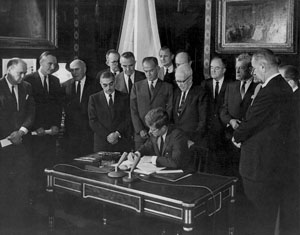 Radiation
Laboratory, was a prominent critic of the test ban movement; he
supported continued testing and, of course, argued that the possibility
of clandestine underground testing made a comprehensive agreement
unworkable. (Note 24)
Radiation
Laboratory, was a prominent critic of the test ban movement; he
supported continued testing and, of course, argued that the possibility
of clandestine underground testing made a comprehensive agreement
unworkable. (Note 24)
The Cuban Missile Crisis of 1962, an event that brought the United
States and the Soviet Union close to the brink, renewed public
concern over the danger of nuclear war. The dangers of the crisis
increased interest on both sides in making progress on the test
ban treaty. Yet, it also became evident that an agreement on a
comprehensive test ban treaty was impossible because the negotiators
failed to reach agreement on the modalities of on-site inspection
for verification purposes. After U.S., British, and Soviet negotiators
had failed to reach an agreement, an irritated Khrushchev told
the British ambassador that the U.S. and British scientists who
favored an inspection system were "only scientists employed
by US and British government which were seeking to introduce spies
into USSR." (Note 25) Yet, until the late
spring of 1963, Khrushchev rejected out of hand a limited agreement,
banning all but underground tests. (Note 26)
Secret backchannel communications between Kennedy, Macmillan,
and Khrushchev, then President Kennedy's speech at American University
in June 1963, broke the ice. Praising Kennedy's speech, which
called for a reduction of Cold War tensions and a fresh effort
on the test ban talks, as "balm," Khrushchev said it
was the "best speech by any president since Roosevelt."
The better political atmosphere reenergized diplomacy and during
the following weeks the three powers agreed to a new round of
high-level discussions in Moscow, with attention focusing on a
three environment test ban (atmospheric, outer space and underwater)
agreement that had been broached by the United States in 1959,
1961, and 1962. For the special mission to Moscow, Lord Hailsham
and W. Averell Harriman represented London and Washington respectively.
(Note 27)
While the Soviets had a complex political agenda, such as an
East-West non-aggression pact that they sought to link to the
test ban, Harriman and Hailsham only gave Moscow lip service on
those issues and focused attention on negotiating a limited agreement
while discretely probing Khrushchev's thinking on China. As the
treaty negotiations unfolded, the Sino-Soviet quarrel intensified
not least because Beijing saw the Soviet role in the test ban
talks as explicitly anti-PRC. (Note 28) Harriman
believed that Khrushchev wanted to use the test ban against the
Chinese to isolate them as "the only nation refusing to cooperate
on this highly emotional subject" (not quite the only, France
would also refuse to sign). The Chinese understood this perfectly
well and during more or less simultaneous talks with Mao's representative,
Deng Xiaoping, the latter vigorously attacked Moscow's positions
on a range of issues. While Kennedy had instructed Harriman to
probe the Soviets on the possibility of joint action against the
Chinese nuclear program, Khrushchev was unresponsive to U.S. hints
that Moscow ought to be concerned about a Chinese nuclear capability.
Indeed, Khrushchev argued that once Beijing had nuclear "means"
they would be "more restrained." (Note
29)
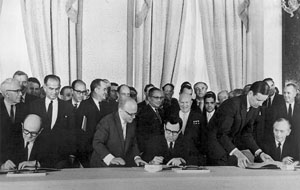
By late July, American, British, and Soviet negotiators had reached
agreement on the text of the Limited Test Ban Treaty, which the
British, Soviet, and U.S. governments signed in Moscow on 5 August
1963. Banning testing in the atmosphere, underwater, and in space,
the treaty left open only the possibility of underground testing,
a more expensive procedure. Some of Kennedy's advisers, recognizing
that a would-be nuclear power could develop weapons through underground
tests, were not sure whether an atmospheric test ban could check
nuclear proliferation. Nevertheless, they "believed it was
worth a try." (Note 30)
Once the treaty was signed, the administration waged a major
campaign to win Senate ratification. Neutralizing important opposition,
the Joint Chiefs approved the LTBT as long as the White House
met its conditions on nuclear testing and expanding national means
to monitor the treaty. Like Eisenhower, Kennedy treated the issue
as a bipartisan question and lobbied to win over doubtful Senate
Republicans. The Republican ultra-right and pro-testing scientists
such as Edward Teller attacked the treaty but years of campaigning
by anti-nuclear activists and White House efforts to develop support
for the treaty paid off; the LTBT enjoyed wide public approval.
On 24 September 1963, the Senate ratified the treaty by a vote
of 80 to 19. Kennedy completed ratification by signing it into
law on 5 October 1963. (Note 31)
In the following years, 108 countries signed the Limited Test
Ban Treaty, the major exceptions being France and China. Although
the Americans, British, and Soviets stopped atmospheric testing,
China and France saw the treaty as an example of superpower hypocrisy
and never signed it. (Note 32) The Chinese exploded
their first nuclear device on 16 October 1964 and held 22 more
atmospheric tests through 1980. France held 50 atmospheric tests
in the South Pacific from the mid-1960s through the mid-1970s.
As the Cold War came to an end, the movement for a test ban revived.
A new moratorium on testing began in the early 1990s (although
later broken by India and Pakistan) and a comprehensive test ban
treaty was negotiated under United Nations auspices. The United
States, Russia, United Kingdom, France, and China signed the CTBT
in 1996. Technologies to monitor and detect underground nuclear
tests have improved significantly to the point where tests above
one kiloton in any environment are detectable with "high
probability." Nonetheless, Senate Republicans blocked the
treaty during the 1990s and presidential candidate George W. Bush
attacked the CTBT on the grounds that it could not be verified
or enforced. Thus, among the 1996 signatories, China and the United
States have yet to ratify the CTBT. (Note 33)
Documents
Note: The following documents are in PDF
format.
You will need to download and install the free Adobe
Acrobat Reader to view.
Part
I: The Eisenhower Administration
Document 1: Armed Forces Special Weapons
Project, "Technical Analysis: Radioactive Fall-Out Hazards
from Surface Bursts or Very High Yield Nuclear Weapons,"
May 1954, Excised Copy
Source: Department of Energy, FOIA release
This document is an analysis of the effects of radiological fallout
produced by the notorious Castle Bravo test held in the South
Pacific of 28 February 1954, whose yield, 15 megatons, far exceeded
the 8 megatons that the weapons testers anticipated. Producing
what has been called the "worst radiological disaster in
American history," the fallout from BRAVO spread hundreds
of miles touching the crew of the Lucky Dragon and generating
a storm of controversy around the world. (Note 34)
This technical analysis, prepared by the Armed Forces Special
Weapons Project--the predecessor of today's Defense Threat Reduction
Agency (DTRA)--discussed the size and patterns of fallout and
how variables such as wind can affect the movement and scope of
fallout. The conclusions showed the deadly power of the Bravo
shot: the detonation of a 15 megaton weapon contaminated "very
large areas" on the order of 5,000 square miles "in
such intensities as to be hazardous to human life." The "radioactive
fall-out hazard [was] a primary anti-personnel effect" of
such high-yield weapons.
Document 2: "Report of NSC Ad Hoc
Working Group on the Technical Feasibility of a Cessation of Nuclear
Testing," 27 March 1958
Source: Dwight D. Eisenhower Library, Records of the Special Assistant
for Science and Technology--Bethe Report
In the fall of 1957, as a consequence of the political shock
caused by Sputnik, President Eisenhower upgraded the role of scientists
on the White House staff by appointing MIT president James Killian
as his science adviser and by creating the President's Science
Advisory Committee (PSAC). Hans Bethe, the Cornell University
physicist (and future Nobel Prize winner), served on PSAC and
chaired a special National Security Council ad hoc working group
on nuclear tests. The Bethe report was a significant step in the
efforts by White House science advisers to mobilize arguments
and information that would convince President Eisenhower to support
a nuclear weapons test ban. Especially significant was the conclusion
that a test ban would leave the United State with important technical
advantages over the Soviets: by the end of 1958, the "U.S.
should be ahead of the USSR in nearly all weight classes [of nuclear
weapons]," although smaller, lighter weight weapons and so-called
"clean weapons" will not have "reached ultimate
performance." Moreover, the Bethe panel argued that it was
technically feasible to verify a comprehensive test ban through
a combination of monitoring stations, on-site inspection, and
overflights. "With such a system agreed to and implemented
the Working Group feels that the USSR could not utilize testing
to improve significantly its nuclear weapons capability, except
for small yields without running a great risk of being detected."
Nevertheless, the panel acknowledged the difficulty of detecting
underground tests, a problem that would dog the test ban movement
for years. (Note 35)
Document 3: Letter from Philip J. Farley,
Special Assistant to the Secretary of State for Atomic Energy,
to Joseph J. Wolf, Director, Office of Political Affairs, United
States Mission to NATO and European Regional Organizations (USRO),
28 March 1958
Source: National Archives, Record Group 59, Department of State
Records (hereinafter RG 59), Records of the Special Assistant
to the Secretary of State for Atomic Energy and Outer Space, Records
Relating to Atomic Energy Matters, 1944-1963, box 349, 18.14 Weapons
Test Moratorium f. Unilateral Suspension by the USSR, 1958
In light of Moscow's campaign for a halt in nuclear tests, analysts
at the State Department looked closely at Soviet motives. During
mid-1950s discussions, Soviet diplomats had made the argument
that a ban on nuclear testing would raise barriers to "countries
which do not yet possess [nuclear weapons]" because they
could not be developed without testing. Writing on behalf of himself,
intelligence analyst Helmut Sonnenfeldt, and European affairs
specialist Robert McBride, Farley suggested that the "Soviets
probably do believe that a test ban would be a relatively cheap
way of stopping or at least inhibiting fourth country nuclear
weapons capability." This could raise obstacles to U.S. nuclear
weapons cooperation with NATO Europe but it could also help the
Soviets "resist any pressure" from China and other "satellites"
for the delivery of nuclear weapons.
Document 4: Department of State memorandum
of conversation (hereinafter, memcon), "Meeting with Disarmament
Advisors," 28 April 1958, excised copy
Source: Dwight D. Eisenhower Library, Office of the Special Assistant
for Science and Technology, box 1, Disarmament - General April
1958
During Eisenhower's second term, the Secretary of State, John
Foster Dulles and his successor Christian Herter, met regularly
with a special panel of disarmament advisers, such former senior
officials and Northeastern establishment luminaries as Robert
Lovett and John J. McCloy. During this meeting, Secretary of State
Dulles expressed his concern about the need for U.S. action to
neutralize its international image as a "militaristic"
nation. A move toward peace such as a nuclear test ban would give
the United States a propaganda coup over the Soviet Union. Besides
a test ban, Dulles laid out a variety of disarmament proposals,
including a cut-off of fissionable materials production and "the
idea that outer space … be used only for peaceful purposes."
While Atomic Energy Commission Chairman Lewis Strauss strongly
objected to a halt in nuclear testing, Dulles argued that failure
to take arms control measures could cause the loss of major allies
such as Japan, Germany, and the United Kingdom. "Do we want
further refinement of nuclear weapons at the cost of the moral
isolation of the United States?"
Document 5: Department of State memcon,
"U.S. Policy on Nuclear Tests," 13 August 1958
Source: National Archives, RG 59, decimal files, 1955-1959, 700.5611/8-1358
This discussion, held just as the Geneva Conference of Experts
was winding up, further illuminates the internal U.S. government
controversy over participation in a nuclear test ban agreement.
The Geneva conference had developed a proposal for an international
monitoring system that would permit relatively high confidence
(80 to 90 percent) in detecting atmospheric and underground tests,
but senior scientists in the nuclear weapons establishment engaged
in controversy over whether it was possible to conceal underground
tests. Thus, Edward Teller, the director of Livermore Radiation
Laboratory, a major opponent of a test ban, argued that it would
be possible to "dampen" the seismic signals produced
by underground tests while Carson Mark, of Los Alamos Laboratory,
took a contrary view. During this meeting, strong Defense and
AEC views in favor of continued testing surfaced. The new Atomic
Energy Commissioner, shipping magnate John McCone argued that
the United States should not stop testing because negotiations
were "likely to go on indefinitely." Presidential science
adviser James Killian suggested, however, that it was worth taking
a chance because "the talks at Geneva had accomplished something
never achieved before in the way of serious discussions of disarmament
controls."
Document 6: Memorandum for the Files of
Lewis L. Strauss, 20 August 1958
Source: Herbert Hoover Presidential Library, Lewis Strauss Papers,
box 69, AEC Memo for the Record
This record of a meeting with President Eisenhower, prepared
by former Atomic Energy Commissioner Lewis Strauss, reflects his
displeasure over White House and State Department decisions in
favor of U.S. participation in a nuclear test moratorium. Livermore
Laboratory director Edward Teller had wanted McCone to lobby Eisenhower,
but the new AEC director did not want a confrontation and asked
Strauss to intervene. While Strauss saw the decision on testing
as a triumph for the Russians and the U.S. Democrat Party opposition,
Eisenhower argued that the flaw in the AEC position was that "it
offered no prospect except an arms race into the indefinite future."
Eisenhower and Strauss did agree, however, to meet Macmillan's
request for nuclear weapons design information; that would assure
British participation in the test moratorium as well as allow
London, in Macmillan's words, to "take [its] proper station
in the defense of the free world." (Note 36)
Document 7: Department of State memcon,
"October 31 US-UK-USSR Negotiations on the Suspension of
Nuclear Tests," 30 September 1958
Source: National Archives, RG 59, decimal files 1955-1959, 700.5611/9-3058
Despite Eisenhower's approval of the moratorium, such influentials
as Edward Teller did not hide their doubts. Pointing out to "loopholes"
in the Geneva system, such as the problem of detecting small nuclear
explosions or "interplanetary" tests, he observed that
Livermore Radiation Laboratory was especially interested in the
problem of developing small nuclear weapons, with several small-yield
"tactical" and "defensive" devices to be tested
before the moratorium began. Noting the lack of knowledge about
"what the Soviets had "done in this yield range,"
Teller constructed an argument about the possibility of concealing
underground tests by reducing the "coupling of the energy
of nuclear explosion by one-third or even one/tenth." Given
this problem, Teller sought an opening for underground nuclear
tests in a partial test ban system, such as permitting tests "that
could not be detected by the system" or with yields below
a specified magnitude.
Document 8: Department of State memcon,
"Geneva Nuclear Test Negotiations," 18 November 1958
Source: National Archives, RG 59, decimal files 1955-1959, 700.5611/11-1858
On 18 November 1959, PSAC member Hans held a "private, delicate"
discussion on the negotiations with acting secretary of state
Christian Herter. While the talks were going "slowly"
Bethe saw the Soviet commitment to the verification plans developed
by the conference of experts as a "hopeful" point. One
sticking point was the U.S. insistence that a test ban treaty
be linked to progress on disarmament generally; Bethe was not
the only one who believed that this position was unworkable and
within a few months Washington would officially abandon it. When
Herter asked about the impact of a long-term test moratorium on
the U.S. nuclear position, Bethe argued that the U.S. nuclear
establishment was "in a far better position to continue nuclear
weapons development" because it was ahead of the Soviets
in understanding of the inner workings of nuclear weapons ("diagnostics").
Perhaps thinking about Teller's arguments in favor of testing,
Herter asked whether the U.S. needed to "improve [its] small
weapons position." Bethe replied that improvements were possible
but that it was not a critically important issue: Washington had
weapons of "every type in every yield." He was more
concerned about the British position on verification because he
believed that they would "be willing to settle for substantially
less than we will" on the grounds that any controls that
the Soviets accepted would be "gravy."
Document 9: Memorandum from President's
Science Adviser James Killian to Acting Secretary of Defense Donald
Quarles, "Review of HARDTACK II Seismic Data," 9 December
1958
Source: Dwight D. Eisenhower Library, Special Assistant to the
President for Science and Technology, box 13, Nuclear Test Suspension-Seismic
Data (1)
A series of underground tests held in 1958, HARDTACK II produced
technical data which complicated the status of the Geneva monitoring
system but erroneously so. According to a preliminary analysis
by AFOAT-1, the Air Force Office of Atomic Energy-1, which was
responsible for tracking foreign nuclear weapons developments,
the data suggested that "it will be much more difficult to
identify a seismic event as a natural earthquake." Moreover,
"the number of earthquakes equivalent to a given low yield
is considerably higher than previously estimated." Those
problems would require a greater number of inspections to determine
whether a suspicious event was an earthquake or a nuclear explosion.
To analyze further the data and the new conclusions and their
implications for the Geneva report, James Killian and John McCone
agreed to create a "board of senior seismologists" in
cooperation with AFOAT-1. As it would later turn out, AFOAT-1
had based its re-evaluation on estimates of the frequency of small
Soviet earthquakes that were "too high by a significant factor."
While the Soviets had rightly challenged the numbers and even
Air Force scientists were wondering about their validity, their
work was so highly classified that it would take several years
before a reevaluation would discover the error. (Note
37)
Document 10: U.S Consulate Geneva Cable
SUPNU 165 to Department of State, 7 January 1959
Source: National Archives, RG 59, decimal files 1955-1959, 700.5611/7-559
Well before the Hardtack errors were discovered, on 5 January
PSAC publicly announced the gist of new data on underground explosions:
that "there will be a substantial increase in the number
of earthquakes that cannot be distinguished from underground nuclear
tests by seismic means alone." This information, which cast
doubts upon the findings of the Geneva conference of experts,
was duly communicated to the British and Soviet delegations at
the Geneva test ban treaties. The Soviets had already expressed
disagreements with U.S. proposals on the control system, e.g.,
they had supported the right to veto recommendations for inspections
by control authorities, and made plain their unhappiness with
Washington's bombshell. Treating the statement on new data as
a "diversion", the Soviets declared that it was "inadmissible
that this political [conference] could take up technical subjects
which would only protract its work." The "only technical
basis on which [they] could proceed" was the report of the
Geneva experts.
Document 11: John S. D. Eisenhower, "Memorandum
of Conversation with the President January 12, 1959 -- 9:00 AM,"
19 January 1959
Source: Dwight D. Eisenhower Library, Ann Whitman File. Dwight
D. Eisenhower Diary, box 38, Staff Notes. January 1959 (II) (Published
in U.S. State Department, Foreign Relations of the United States
1958-1960, Volume III (Washington, D.C.: Government Printing
Office, 1996), pp. 687-690)
During this White House meeting, Eisenhower agreed on the importance
of breaking the disarmament-test ban linkage, supporting the view
that the issue of the "control system" was the "heart
of the matter and that the "breaking point" with the
Soviets had to be the control system. During the course of the
discussion, Eisenhower and his colleagues reviewed U.S. motivations
for supporting the moratorium ("propaganda mileage"),
doubts that the Soviets would ever approve a "true agreement,"
the importance to the "Free World" of inserting "qualified
observers within the USSR," and the difficulties that the
United States would have "in carrying out a treaty of this
type." If an agreement allowing for many observation posts
was not negotiated, Eisenhower believed that the difficulties
in test detection could make it necessary for the United States
to conduct small underground tests. The more difficult, immediate
problem, as Dulles observed, was "our reversal of position
as to the size of the explosion which may be detected underground."
This "will appear to the Soviets as a breach of faith."
The United States was in a "bad spot."
Document 12: State Department Memcon, "U.S.
Position in Geneva Test Negotiations," 30 January 1959
Source: National Archives, RG 59, decimal files 1955-59, 396.12-GE/1-359
AEC chairman McCone was less concerned about a "breach of
faith" than he was with the impact of the new data on the
U.S. nuclear position. During a meeting with Dulles, he pushed
for change in the U.S. negotiating position: ban atmospheric nuclear
tests but permit underground testing until the verification issues
had been resolved. Dulles heard McCone out, but argued that the
AEC proposal was politically impossible. Even if there was only
a small, one in a hundred, chance that Moscow would accept U.S.
terms for a treaty, "public relations" necessities required
Washington to stick to the plan for a comprehensive test ban.
If the McCone proposal was put on the table, it would "allow
the Russians to break off the negotiations with the United States
with the United States bearing the entire blame for their failure."
As it was, Dulles believe that press coverage had already inflamed
tensions with the Soviets with the latter arguing that the articles
confirmed that "we were looking for a way to break the negotiations
off." Recognizing that he could not win an argument with
Dulles, McCone backed away from his proposal although suggesting
that Dulles' own State Department may have been the source of
the leaks that had inspired the press coverage.
Document 13: John McCone, Memorandum to
the File, 23 March 1959
Source: Freedom of Information Act Request to Department of Energy
In March 1959, British Prime Minister Macmillan, concerned about
the ongoing Berlin crisis and the test ban stalemate, traveled
to Washington to meet with Eisenhower. With Dulles hospitalized
and out of action, McCone had another opportunity to lobby for
his limited test ban proposal. He believed that Eisenhower supported
his position and was confident that "AEC's position is now
pretty well recognized as the proper one." Nevertheless,
Macmillan believed it was more important to "break on the
question of the veto and … not inject these new technical
considerations at this time." Macmillan also pointed to the
role of non-proliferation concerns in the movement for the test
ban treaty. Suggesting that permitting any testing could give
a loophole to would-be nuclear powers, Macmillan said that the
problem of "Nth power development" made it unwise to
permit continued underground testing.
Document 14: State Department memcon, "Nuclear
Test Negotiations," 26 March 1959
Source: National Archives, RG 59, decimal files 1955-1959, 700.5611/3-2659
A meeting of the Committee of Principals, the most senior inter-agency
group on arms control issues, held a few days later led to agreement
that if the Soviets stuck to ideas about a veto on inspections,
the U.S. and the British should offer a ban on atmospheric nuclear
tests with "collaboration on a program of underground tests
to test improvements in the detection system." If, however,
the Soviets dropped the veto, acting Secretary of State Herter
observed that Washington would have to live with an "imperfect"
detection system. "The President feels that we need to be
sure only that there is a reasonable level of deterrence."
This worried McCone who thought it was a "new concept"
but test ban negotiator James Wadsworth and State Department official
Philip Farley argued that the notion of deterrence had been part
of the government's thinking on the test ban since negotiations
began; "the inability to achieve 100 percent perfection was
recognized."
Document 15: Department of State cable
TOSEC 59 to U.S. Consulate Geneva, 16 May 1959, enclosing letter
from Khrushchev to Eisenhower dated 15 May 1959
Source: National Archives, RG 59, decimal files 1955-1959, 700.5611/5-1959
With the impasse over the veto, on 13 April, Eisenhower, with
Macmillan's support, presented a new proposal that was close to
McCone's suggestions: a ban on tests in the atmosphere up to 50
kilometers, with additional negotiations eventually expanding
the scope of the agreement. (Note 38) The Soviets
rejected this proposal in the name of a comprehensive test ban,
but as this document shows Khrushchev was giving ground on the
veto question. He suggested that sending inspectors to investigate
suspicious physical phenomenon would be the principal means for
verifying the treaty. According to Khrushchev, an agreement on
a specific number of inspection team visits would "preclude
the necessity of voting on obtaining agreement on that question
within the control commission." He did not propose any specific
number but suggested that "no large number would be necessary."
The fact that they could occur, he argued, would have a "sobering
effect" on the signatories, tacitly deterring any cheating.
Whether London, Moscow, and Washington could agree on what "no
large number" meant would be a decisive issue in reaching
a negotiated test ban.
Document 16A: State Department memcon,
"Geneva Nuclear Test Detection Negotiations," 17 June
1959
Source: National Archives, RG 59, decimal files 1955-1959, 700.5611/6-1759,
excised copy
The Principals met on 17 June for more detailed discussion of
the problem of on-site inspection (after first briefly reviewing
ongoing studies of high-altitude test detection). Director of
Central Intelligence Allen Dulles gave a short and optimistic
briefing of the role that intelligence could play in detecting
treaty violations, e.g., the relative ease in detecting moving
earth for underground tests. While Under Secretary of Defense
Thomas Gates was not so sure that intelligence could spot violations,
Spurgeon Keeny, on the staff of the White House Science Adviser,
saw a hopeful note: the statistician John Tukey was developing
concepts for "maximizing the effectiveness of a choice of
inspections" and that intelligence could provide data to
increase the effectiveness of the "Tukey system". (Note
39) The uncertainties led the group to commission another
study that James Killian was already directing. Further discussion
of on-site inspection brought out the possibility that a "budget
of 100 inspections per year" would provide a "high probability
of catching any violations." Even a lower figure would provide
a "high probability." McCone suggested that 100 would
not be quite enough: "100 inspections would allow inspection
of all events above 5 kilotons and about five percent of those
under that figure." That plainly innocuous sentence was excised
from the 1998 release at the National Archives although it was
declassified during the early 1990s at the Eisenhower Library.
See Document 16B for a comparison.
[Source of 16A: Dwight D. Eisenhower Library, Records of Special
Assistant to the President for Science and Technology. Killian-Kistiakowsky
Records, box 8, Disarmament-Nuclear Test Policy, May 1958-Oct
1960]
Document 17A: State Department memcon,
"Geneva Nuclear Test Negotiations -- Meeting of the Principals,"
9 July 1959, excised copy
Source: Dwight D. Eisenhower Library, Office of Special Assistant
for Science and Technology, box 8, Disarmament - Nuclear Test
Policy. May 1958 - October 1960 (folder 2)
While negotiations continued, the Committee of Principals met
to hear a report on detection and on-site inspection of underground
tests by Caltech scientist Robert F. Bacher. Noting that the seismology
was "still in its infancy", he suggested that theories
about evading test detection through decoupling "held forth
possibilities which could change the underground detection situation
completely." He was skeptical, however, of the "complicated"
decoupling theory that had RAND scientist Albert Latter had advanced
because it would "require an approximately 1 million-cubic
meters hole for a 10 kiloton explosion" at a cost of 2 to
4 million dollars. Nevertheless, Bacher declared that, despite
the "Latter hole's" apparent impracticality, it "has
stood up against severe theoretical scrutiny." (Note
40) Bacher also made a series of recommendations on the problem
of on-site inspections, especially whether inspection should be
based on a percentage or a quota. While some of his recommendations
are excised, they pointed to the uncertainties of detecting underground
tests and the need for continued study on ways to reduce the doubts.
Further study would eventually lead to the Vela project findings
that U.S. experts had overestimated the problem of small earthquakes
in Soviet territory.
This document has been through several declassifications, most
recently in State Department records at the National Archives.
In 1998, the Department of Energy reviewed it and withheld even
more information than it had withheld in 1990. Interestingly,
however, it released innocuous language from page 3 that had been
excised in 1990. See Document 17B
for a comparison. [Source: National Archives, RG 59, decimal files,
1955-1959, 700.5611/7-759)
Document 18: Comments on Bacher panel's
report delivered by White House Science Adviser Kistiakowsky during
meeting with Eisenhower, 23 July 1959
Source: Dwight D. Eisenhower Library, Office of Special Assistant
for Science and Technology, box 9, Disarmament - Nuclear Testing
Policy (4)
Not long after the Committee of Principals heard the Bacher panel
report, President Eisenhower heard a briefing from science adviser
George Kistiakowsky summarizing Bacher's findings. Using the erroneous
data about the frequency of small earthquakes on Soviet territory,
George Kistiaskowsky, who had replaced Killian as White House
Science Adviser, underlined the uncertainties of underground test
detection. Unless the United States inspected all seismic events
in the Soviet Union that were the equivalent of a half-kiloton
explosion, about 1715 annually, he argued that the "probability
of identifying at least one out of a series of below 5 kilotons
is negligible." The possibility of decoupling the seismic
signal from an underground nuclear test through the "Latter
Hole" increased the uncertainty. Hypothetically, a nuclear
power could test a 100 kiloton weapon decoupling it by a "factor
of 200." The resulting half kiloton signal would be virtually
undetectable. Briefed on these uncertainties, Eisenhower concluded
that it "appeared impossible to control underground tests".
(Note 41) During the months that followed, Eisenhower
began to favor a limited agreement involving a joint U.S.-British-Soviet
study program of underground test detection. It would take some
time, however, before the administration was ready to take a step
that represented a significant detour from the goal of a comprehensive
ban.
Document 19: State Department memcon, "Meeting
of the Secretary's Disarmament Advisers," 3 November 1959
Source: National Archives, RG 59, decimal files 1955-1959, 600.0012/11-359
Sharp inter-agency disagreements over whether to publicly abandon
the goal of a comprehensive test ban and resume nuclear testing
persisted but the State Department's stance against any sudden
policy changes prevailed. Instead, the Department supported proposals
for technical discussions with the Soviets as a way to "sharpen
the issue of underground control to the point where we could propose
a limited agreement" that would include provisions for a
research program on underground test verification. (Note
42) During an early November 1959 meeting with "establishment"
disarmament advisers, Philip Farley reviewed the state of play.
At Geneva, the U.S. had presented the Soviets with technical conclusions
on underground testing that could bring Washington "face
to face with the question of whether we are going ahead with a
proposal for a limited treaty and either resume tests or declare
our freedom of action with respect to further testing." The
Soviets were unlikely to accept a limited treaty while the British
were seeking a three year moratorium on underground testing. That
concerned the State Department because, as Herter put it, the
West would "get nothing in return." Nevertheless, he
recognized the need for some give in the West's position because
world opinion was suspicious of the U.S. stance. As former Supreme
Allied Commander Europe (SACEUR) General Gruenther explained many
believed that the U.S. was pushing the difficulty of underground
test verification as a "device to get out of the negotiations."
Killian explained the theoretical challenge posed by the "Latter
Hole" although McCloy was doubtful because "the difficulties
of constructing the big hole were almost insurmountable."
The advisers also discussed the UN disarmament committee, the
Charles Coolidge study on disarmament, and the problem of "stability
in the missile age," which concluded with Gruenther's sardonic
statement that to "to proceed with disarmament we will have
to increase our defense expenditures."
Document 20: Atomic Energy Commission "Record
of Cabinet Meeting, 11 December 1959 Consideration of Test Moratorium
Negotiations," 14 December 1959, excised copy
Source: Dwight D. Eisenhower Library, Special Assistant to the
President for National Security Affairs, NSC Series, Briefing
Notes Subseries. Box 2. Atomic Testing Suspension of Nuclear Testing
and Surprise Attack (3)
In mid-December, cabinet and sub-cabinet level officials met
with Vice President Nixon to discuss the parameters for a forthcoming
presidential decision: whether to extend the moratorium into 1960.
While the Soviet delegation had, in November 1959, assented to
Anglo-American proposals for technical discussions of the underground
test verification problem they would refuse to accept the conclusion
that the Geneva monitoring system needed rethinking. In Washington,
Secretary Gates and the Defense Department continued to press
for resumed testing but other Principals were more focused on
the verification problem. Plainly, the resumption of testing was
not feasible; as Nixon observed in his wrap-up, given Eisenhower's
recent "good-will trip", the anticipated heads of state
summit, and a scheduled Presidential trip to Russian, it would
be difficult for Eisenhower to announce a program of underground
tests without sharpening global tensions. Therefore, at the end
of the month, Eisenhower publicly expressed his concern over the
state of the negotiations and the "politically guided Soviet
experts" who would not take seriously scientific findings
on seismic detection. Giving something to McCone and the Pentagon,
he announced that the moratorium would end on 31 December, leaving
the United States "free" to resume testing; nevertheless,
in a bow to anti-testing sentiment, the United States would suspend
testing on a voluntary basis and try to negotiate a treaty. (Note
43)
Document 21: Letter from Harold Brown to
John McCone, 26 December 1959
Source: Dwight D. Eisenhower Library, John McCone Papers, box
7, Test File - December 1959 (1)
Harold Brown, soon to be director of Livermore Radiation Laboratory
and a future Secretary of Defense, served as scientific adviser
to the U.S. test ban negotiating team at Geneva during 1958-1959.
In this letter, he related his discouragement over the technical
talks with Soviet scientists on the problem of underground test
detection. While the Soviets had been cooperative in private discussions,
even accepting U.S. claims about decoupling, in public sessions
"they denied it." Moreover, Brown argued that in recent
weeks U.S. scientists in Geneva had concluded that detection "system
capability is considerably less than believed even a few months
ago." Not only did successful on-site inspection have a "very
small" probability of success, but "large hole decoupling"
was "much easier than had been thought." Brown's comments
on the possibilities of evasion suggested that the demands on
U.S. intelligence capabilities were much greater than Allen Dulles
had suggested a few months earlier (see Document
17). Just as McCone had suggested a "threshold"
test ban in the meeting with Nixon, Brown was thinking along the
same lines, in this instance a ban on atmospheric tests and on
"underground for yields higher than about 100 or 150 kilotons."
These suggestions presaged future policy developments. Thus, in
early February 1960, the U.S. proposed a limited test ban treaty
banning atmospheric, underwater, and high altitude tests and underground
tests above a 4.75 seismic magnitude reading--the equivalent of
19 or 20 kilotons of explosive yield--the threshold at which underground
tests could be adequately monitored. Moreover, the three powers
would begin a joint research program on improvements of underground
test detection below the threshold.
Document 22: State Department memcon, "Geneva
Nuclear Test Negotiations: Meeting of Principals," 22 March
1960
Source: National Archives, RG 59, decimal files 1960-63, 397.5611-GE/3-2260
The Soviets, not wanting to break the momentum behind the negotiations,
accepted the threshold proposal on the condition that Washington
accept a moratorium on sub-threshold underground tests while the
parties conducted joint research program on test detection. Meeting
on the eve of a visit by Prime Minister Macmillan to Washington,
the Principals reviewed the issues. Macmillan strongly supported
extending the moratorium; while his support was not necessarily
determining that made it more difficult to reject the Soviet offer
outright. McCone and Deputy Secretary of Defense Douglas argued
against a commitment to extend the moratorium without "controls"
but they did not persuade other officials who believed that Washington
had to address positively this "first magnitude" problem.
Acknowledging that the Soviet proposal was not a good one, that
Eisenhower could not commit his successor to a moratorium, and
that Moscow had made no concessions on on-site inspection, Herter
and his colleagues reminded the Principals that "the international
state of mind is one of opposition to nuclear tests." Science
adviser Kistiakowsky observed that a three year research program
"could result in major progress on the detection and identification"
fronts, but there was no "guarantee" that it would.
As it turned out, Eisenhower rejected some elements of the Soviet
proposal but disregarded AEC-Defense advice by accepting a one-year
moratorium on underground tests (with the next president deciding
on whether to continue it). He realized there were risks but that
"he could not stand out against some kind of reasonable solution
on this issue." The final arrangement would have to be negotiated
at the summit, including the number of inspections which Khrushchev
would not discuss except at the highest level. (Note
44)
Document 23: State Department memcon, 29
March 1960
Source: National Archives, RG 59, Policy Planning Staff Records,
1957-1961, box 140, Great Britain, 1960-1961
With Eisenhower and Macmillan in agreement on an approach to
the Soviets on the test ban, it was necessary to discuss the problems
of a joint research program with Moscow on underground tests detection.
Kistiakowsky believed that more research might enable the 180
station network to reach the 90 percent level of certainty posited
by the Geneva experts, although the problem of "muffled or
decoupled shots" would remain. Eisenhower remained unruffled
about the low prospects for a 100 percent certainty and Kistiakowsky
assured him that with a "reasonable number" of on-site
inspections, "any potential violator would face a real risk
of getting caught." The participants also discussed the problem
of special nuclear weapons tests for research purposes and agreed
that it was possible to establish safeguards so that the Soviets
would not think that Washington was trying to improve its nuclear
stockpile. In what would turn out to be a short-lived proposal,
Kistiakowsky suggested declassifying for this purpose a "simple
gun-type of nuclear weapon which would be of little value to a
potential Nth country" proliferant. Apparently, he assumed
that a would-be nuclear power would be interested in acquiring
more efficient, advanced-design nuclear weapons. That the problem
of nuclear proliferation was assumed to preoccupy the Soviets
is also plain from Macmillans' statement that the Soviets wanted
a sound agreement because of their concerns about the spread of
nuclear weapons. Noting the development of gas centrifuges for
producing highly-enriched uranium, McCone implied that the nuclear
proliferation problem could become a serious one.
Document 24: State Department memcon, "Nuclear
Test Negotiations - Meeting of Principals," 10 May 1960
Source: National Archives, RG 59, decimal files 1960-63, 700.5611/5-1060
By early May, the U-2 crisis was unfolding which doomed the Paris
summit. Nevertheless, in the hope that something might turn up,
the Principals met to discuss black boxes and seismic research,
high altitude tests, and the U.S. position on inspection quotas.
Interestingly, the participants had second thoughts about declassifying
nuclear weapons designs for special tests; as Herter observed,
"black box" seismic stations would "obviate the
necessity of declassifying devices which might have served to
increase the nuclear capability of other States." Detecting
high altitude tests and missile launches had been a continuing
concern and the Principals discussed the latest research which
would permit ground-based systems to detect the former and Midas
satellites that could discern the latter. Doyle Northrup, Technical
Director for Air Force Technical Application Center (AFTAC), the
organization responsible for detecting nuclear weapons programs
abroad, startled the Principals when he stated that a recent cost
estimate for establishing 22 control posts in the Soviet Union
with 100 seismic arrays at each one was between one and five billion
dollars. Northrup promised the budget-conscious Principals more
research on costs noting that no one had tried to estimate the
expense of establishing "unmanned stations" in the Soviet
Union. The number of inspections received inconclusive discussion,
although the Principals eventually agreed to a proposal for inspection
of 20 percent of unidentified events above the 4.75 threshold,
about 20 inspections annually. The group also heard a briefing
by Albert Latter on a RAND Corporation study on ways and means
to increase the effectiveness of control posts in identifying
seismic events. Through redistributing and increasing control
posts on Soviet territory, Latter suggested that it would be easier
to identify earthquakes and narrow the range of events that required
inspection. Herter received the RAND briefing with enthusiasm
suggesting that it pointed to "tremendous" possibilities
in identifying seismic events.
Document 25: Central Intelligence Agency,
Office of Current Intelligence, Current Intelligence Weekly
Summary, 24 August 1960, excerpt on "The Nuclear Test
Ban Talks"
Source: National Archives, RG 59, Records of Charles E. Bohlen,
1952-1963. Box 16. Miscellaneous 1960
This CIA document provides a useful account of the verification
issues that divided the United States and the Soviet Union during
first two years of the test ban negotiations. It is particularly
useful for summarizing developments after the collapse of the
summit. Abandoning their position that the number of inspections
could be discussed only at the heads of state level, in July 1960
the Soviets offered three "veto-free" annual inspections
inside the Soviet Union of any suspicious events. They rejected
the U.S.-British proposal for 20 inspections a year. These positions
set the stage for a protracted debate on on-site inspection that
would force both sides back to a limited test ban proposal.
[Note: a typographical error occurs on document's first page,
second column: December 1959 should read December 1958.]
Part
II: The Kennedy Administration
Document 26: Glenn Seaborg, Chairman, Atomic
Energy Commission, Journal Entry for 19 April 1961
Source: Journals of Glenn T. Seaborg, Volume 1, February 1, 1961-June
30, 1961 (Berkeley, CA: Lawrence Berkeley Laboratory, 1989)
At a meeting of the National Security Council, Eisenhower's successor,
John F. Kennedy, showed his lack of enthusiasm for the early resumption
of nuclear testing. Not only would world opinion likely to be
"very adverse", other factors had to be considered,
one of which--whether the Soviets were covertly cheating--was
raised by Kennedy's national security assistant McGeorge Bundy.
DCI Allen Dulles could not give any assurances either way; it
would be a "matter of luck" whether the intelligence
system detected a low-yield Soviet test. Kennedy raised a number
of issues that would have to be addressed before he was ready
to make any decision, such as whether there was to be any give
in the Soviet position, the location of testing, and how long
testing would continue.
Document 27: Memo from Woodruff Wallner,
Bureau of International Organizations, to Assistant Secretary
of State for International Organizations, Harlan Cleveland, "Meeting
of the Principals on Future United States Policy on Nuclear Test
Negotiations," 24 May 1961
Source: National Archives, RG 59, decimal files 1960-63, 711.5611/5-2461
The NSC meeting on 19 May included a briefing by Director of
Defense Research and Engineering Harold Brown (formerly, director
of Livermore Radiation Laboratory and a member of the U.S. delegation
to the Geneva test ban talks); Seaborg did not include any details
in his journal, but some of Brown's points may appear in this
record of a Committee of Principals meeting from a week later.
After the Committee heard negotiator Arthur Dean on the "dim"
prospects for an agreement, Secretary of Defense Robert McNamara
argued that a new round of tests would reduce the costs and increase
the effectiveness of the weapons stockpile. While the intelligence
on Soviet intentions was ambiguous but laden with suspicion, the
feeling among scientists and defense officials was that the United
States "could not afford not to move forward in the nuclear
testing field because we don't know what others will do."
Some observers found this less than convincing and, like his predecessors,
Secretary of State Rusk "pointed out the serious political
reaction that we would have to expect were we to resume testing."
Rusk left the meeting early and the meeting was inconclusive,
but the momentum to end the moratorium would prove irresistible,
especially when tensions with Moscow sharpened during the summer
of 1961.
Document 28: State Department Instruction
to U.S. Embassy Japan, W-24, "Briefing of the Japanese Government
Concerning Developments in Nuclear Test Ban Negotiations,"
22 July 1961
Source: National Archives, RG 59, decimal files 1960-1963, 600.0012/7-2261
While pressure for resume testing mounted, the Kennedy administration
continued the negotiating track at Geneva. The Japanese government
had a special interest in the test ban and the Kennedy administration
realized that it was critically important to show Tokyo that it
was making a good faith effort on this issue, in order to assure
Japan's support for securing a UN General Assembly endorsement
of a treaty with "effective controls." With this message
to the embassy in Tokyo, the State Department sent briefing material
showing its efforts to negotiate a treaty. Included in the briefing
paper was a description of the "compromise proposals"
that the Americans and the British had tabled in March and May.
As before the treaty posited a threshold test ban but the moratorium
on underground tests was increased from two to three years, the
number of on-site inspections could be as low as 12 (instead of
20), while the number of number of control posts in the Soviet
Union would be reduced to 19 (instead of 22). From the State Department
standpoint, the Soviets had "made no constructive response"
to this proposal.
Document 29: McGeorge Bundy, "Memorandum
of decision, July 27, 1961: test ban scenario," 28 July 1961
Source: National Archives, RG 59, decimal files 1960-1963, 600.0012/7/2859
(also published in Foreign Relations of the United States,
1961-1963, Volume VII, Arms Control and Disarmament (Washington,
D.C.: Government Printing Office, 1995), pp. 114-115
The deepening crisis over West Berlin, in the wake of the chilly
Kennedy-Khrushchev Vienna summit made the White House far more
interested in testing. Against the background of decisions on
military preparations for a possible confrontation over Berlin,
Kennedy requested science advisers to prepare a study on the technical
issues associated with the resumption of testing. The report,
chaired by Stanford University physicist Wolfgang Panofsky, did
not see any urgent necessity to resume testing and acknowledged
that without tests, "the U.S. would retain a degree of technological
superiority in nuclear weapons for some time." Whether the
Soviets were secretly testing, as some in the military were charging,
was an unknown. Given the ambiguous picture, the panel concluded
that "non-technical"--that is, political and military
considerations--would have to shape a final decision on testing.
As this decision memo suggests, Kennedy believed that the problem
of international opinion made it difficult to start testing soon,
without another stab at test-ban diplomacy and appearances before
the United Nations. Nevertheless, measures should be taken to
prepare for tests "not earlier than 1962." A few days
later, the State Department recommended the "achievement
of a state of technical readiness" for "significant
test series", although the problem of international opinion
made it necessary to defer any announcement of testing. In light
of this recommendation and even stronger one from the Joint Chiefs
(who were highly critical of the Panofsky report), Kennedy told
the National Security Council in early August that "we have
here a major political problem. We should clearly resume testing
fairly soon, but the UN problem is a serious one." (Note
45)
Document 30: State Department cable 6955
to U.S. Embassy India, 24 August 1961
Source: National Archives, RG 59, decimal files 1960-1963, 600.0012/8-2461
In late August, the negotiating track at Geneva continued, with
Ambassador Dean offering a new proposal that involved lowering
the threshold as well as clustering monitoring stations in earthquake
zones. President Kennedy was worrying about the position of the
neutral Third World nations, not least the government of India,
which had supported a United Nations resolution in favor of an
unlimited moratorium without the controls that Washington found
essential. Writing to his close acquaintance, the famous economist
and Ambassador to India John Kenneth Galbraith, Kennedy wanted
Prime Minister Nehru to understand that despite the U.S.'s efforts,
the Soviets had "lost interest in any effective treaty."
Kennedy expected that any renewed U.S. initiative at Geneva would
be rebuffed and that Washington would have to approach the United
Nations for a "good resolution of our own on nuclear testing."
While Kennedy hoped that Galbraith's "strong effort"
could persuade Nehru to support the U.S. position, a few months
later the Indian government would win UN support for a resolution
favoring a comprehensive test ban without inspections.
Document 31: Draft "JAEIC Statement,
1430 Hours, 1 September 1961"
Source: National Archives, RG 59, Records of the Special Assistant
to the Secretary of State for Atomic Energy. Country and Subject
Files Relating to Atomic Energy Matters, 1950-1962, box 5, 1961
USSR Test Papers and Memos
The Soviets solved the White House's political problem by testing
first, which they announced a day ahead on 31 August 1961. Acoustic
sensors that were part of AFTAC's Atomic Energy Detection System
(AEDS) identified the first Soviet detonation almost as soon as
it had occurred. Other sensors, electromagnetic and seismic, had
not yet yielded any information so the analysts could only guess
that the detonation's yield was about 150 kilotons. The Joint
Atomic Energy Intelligence Committee (JAEIC), which was responsible
for coordinating nuclear intelligence, promulgated the first details
as soon as they had been assessed. A few days later, on 3 September,
Kennedy and Macmillan publicly responded to the Soviet tests with
a joint statement calling for an atmospheric test ban that would
be policed by national verification systems. (Note
46)
Document 32: Atomic Energy Commission Chairman
Glenn Seaborg, Journal Entry for 5 September 1961
Source: Journals of Glenn T. Seaborg, Volume 2, July 1, 1961-December
31, 1961 (Berkeley, CA: Lawrence Berkeley Laboratory, 1989)
Khrushchev formally rejected the Kennedy-Macmillan proposal on
9 September, but events a few days earlier convinced Kennedy that
the Soviets had already made a decision. On 5 September, during
a talk with AEC chairman Seaborg, he discussed plans to resume
underground testing later in the month. To avoid "adverse
comment" about U.S. military power; he wanted the first test
to have a yield that was "larger" than the first Soviet
test whose explosive yield was 100 kilotons. Seaborg told him
that the AEC could not arrange a large test before 15 September;
a larger one involving the Terrier air defense missile would occur
later. Kennedy did not make a decision at the meeting, but when
he learned that the Soviets had held their third test, he ordered
the resumption of underground testing, with the first detonation
to occur on 15 September. Kennedy was not sure if it was the "right
decision," he later explained to UN Ambassador Stevenson,
but "What choice did we have? They had spit in our eye three
times. … [Khrushchev] wants to give out the feeling that
he has us on the run. The third test was a contemptuous response
to our note." No doubt Kennedy was disappointed by the explosive
yield of the first test that occurred on 15 September: 2.6 kilotons.
(Note 47)
Document 33: State Department memcon, "The
International Situation," 8 September 1961
Source: National Archives, RG 59, decimal files 1960-1963, 600/0012/9-861
This conversation between Robert Matteson, a Foreign Service
Office assigned to the U.S. mission to the United Nations, and
one of his Soviet counterparts, Igor Usatchev, highlights the
tensions over Berlin and nuclear testing. Soviet threat to sign
a treaty with the GDR, which would "do away with the occupation
rights in West Berlin," remained a source of great anxiety
in the West, even after the East Germans had started to build
the wall. Usatchev also shed light on the concerns motivating
Moscow's decision to break the moratorium; he saw Soviet military
activity as a "reaction" to President Kennedy's military
buildup but also to the more advanced U.S. nuclear weapons program.
While the U.S. had tested "over a hundred" (actually,
closer to 200), the Soviets had conducted 70. The Soviet diplomat
may have astonished his interlocutor with his emphasis on Moscow's
interest in a 100 megaton weapon, which he saw as advantageous
militarily, partly because it would conserve scarce fissile materials.
The Soviets did not test a 100 megaton device but some weeks later
tested one of half that strength, an event that would shock the
world.
Document 34: "Policy Planning Council-JCS
Joint Staff Meeting," 14 September 1961, with enclosures:
State Department cable to U.S. Embassy Moscow, 7 September 1961
and Moscow embassy cable to State Department, 9 September 1961
Source: National Archives, RG 59, Policy Planning Staff Records,
1957-1961, box 133, State-Defense Relationship
During one of their regular consultations, State and Pentagon
officials considered possible Soviet motivations for resuming
nuclear test. Besides Moscow's interest in the development of
smaller yield weapons, the Soviets wanted to test anti-ballistic
missile weapons as well as a "triggering device for a huge
nuclear weapon." "[P]sychological" reasons were
briefly mentioned; the participants may well have agreed that
Khrushchev was trying to overawe the West during the Berlin crisis.
This did not perturb the Joint Staff representatives who believed
that the Khrushchev "must know that we have enough power
now to knock Russia `off the map'." The Joint Staff agreed
with an assessment signed by Ambassador Lwelleyn Thompson, the
State Department's astute Khrushchev watcher. Noting Moscow's
"defensive" posture and the possibility that the Soviets
"consider their position relative to our as worsened",
Thompson nevertheless cited Khrushchev's private statements that
"we are substantially equal in our ability to damage each
other." Like other observers, Thompson saw the Soviet test
series as an effort to "obtain more sophisticated warheads
which would require less material for the same effect."
Document 35: AEC Chairman Glenn Seaborg
to President Kennedy, 19 October 1961
Source: John F. Kennedy Library, National Security Files, box
267, Atomic Energy Commission
While the U.S. was conducting its underground test series, the
directors of the AEC nuclear weapons labs reinforced earlier pressure
to resume atmospheric nuclear testing, to test large yield weapons
but also a variety of tactical nuclear weapons. Testing would
occur in the Pacific, although some at the Nevada test site, with
total fission yield limited to reduce fallout. Despite the interest
in atmospheric testing, costlier underground testing would continue
"to improve our techniques" in the event an atmospheric
test ban came to pass. Seaborg suggested that President Kennedy
approve atmospheric tests while the Soviets were holding their
own series because the "reaction and pressure against it
might be much more severe" if Washington held such tests
later. Kennedy had authorized preparations for them, although
he would not make a final decision for several months.
Document 36: State Department Circular
Cable 728 to All U.S. Diplomatic Posts, 18 October 1961
Source: National Archives, RG 59, State Department Decimal File,
761.5611/10-1861
As Igor Usatchev had noted, the Soviets had plans for enormously
high-yield nuclear tests; the State Department got word that Khrushchev
had announced, at the Party Congress, an impending test of a 50
megaton weapon at the end of October. Washington quickly seized
this development by instructing U.S. diplomats to attack the planned
test as "nuclear blackmail", as "totally unnecessary"
and "irresponsible" and "motivated primarily by
desire for political rather than military advantage." Mindful
of preparations to resume atmospheric testing, the Department
cautioned diplomats to focus on the problem of high yield atmospheric
tests and to take care to avoid a "situation in which it
would not be politically possible for us to conduct certain atmospheric
tests should be it … prove essential to do so." The
U.S. campaign against the test was highly successful and resulted
in a UN General Assembly resolution urging Moscow not to hold
the test. In addition, the General Assembly supported a test ban
treaty with the verification and control measures that London
and Washington had supported. Nevertheless, on 30 October the
Soviets exploded a 50 megaton monster bomb at a height of 4,000
meters. "The flash of light was so bright that it was visible
at a distance of 1,000 kilometers, despite cloudy skies. A gigantic,
swirling mushroom cloud rose as high as 64 kilometers." (Note
48)
Document 37: Memorandum from Air Force
Chief of Staff Curtis LeMay to Gerald W. Johnson, Assistant to
the Secretary of Defense (Atomic Energy), "USAF Briefing
for Dr. Teller on Nuclear Testing," 31 October 1961, with
enclosing memoranda by Generals Victor Haugen and Roscoe Wilson
and report on "Priority of Nuclear Weapons Tests of Primary
Interest to the Air Force," 25 October 1961
Source: Library of Congress, Curtis LeMay Papers, box 127, Chief
Scientist, 1961
General Curtis LeMay, the Air Force Chief of Staff, the founding
father of the Strategic Air Command, and a fervent proponent of
nuclear testing, sought scientific support for testing of Air
Force weapons. His advisers turned to the Air Force's official
scientific advisers but also to Edward Teller, then serving as
Professor at Large in the University of California system. Indeed,
Teller and the Air Force Scientific Advisory Board "strongly"
supported atmospheric testing in order to provide scope for a
variety of tests. Among those experimental items (X) on the wish
list were the XW-50 (deployed on the Pershing I missile in 1963),
XW-56 and 59 (later deployed on Minuteman), and the TX-43 bomb
(later deployed on a number of aircraft). (Note
49) When commenting on the Soviet 50 megaton test, Teller
and his associates observed that that event had "reawakened
interest in high-yield testing by the United States." Astonishingly,
they suggested consideration of weapons with yields up to 1000
megatons (!) "for their possible military use." The
subject of high yield weapons would generate much thinking and
planning in the following years, but the fantastic notion of 1,000
megaton weapons appears to have dropped by the wayside.
Document 38: State Department cable 3639
to U.S. Embassy France, 29 December 1961
Source: National Archives, RG 59, decimal files 1960-63, 700.5611/12-2959
In November 1961 the Soviets proposed a three environments test
ban, with an indefinite moratorium on underground tests while
a control system was developed. National verification systems
would monitor the treaty; there were no provisions for inspection.
In early 1962, when the Geneva talks reconvened, the Americans
and British rejected the proposal and the conference adjourned
indefinitely. The doubtful future of negotiations made a decision
for atmospheric testing likely; during meetings held in Bermuda,
Kennedy and Macmillan reviewed the situation. This State Department
cable summarizes the key discussions. Informing Kennedy's views
was the consensus among American and British technical experts
that, despite the Soviet test series, the United States "retains
over-all nuclear advantage," without U.S. atmospheric testing,
the Soviets could "gain over-all advantage in two or three
years," especially in anti-intercontinental ballistic missile
(AICBM) weapons tests. Appalled by the "risks" and "waste"
of the arms race, Macmillan urged Kennedy to reach out to Khrushchev
to reach a test ban agreement. Kennedy believed, however, that
a personal appeal to Khrushchev would reduce U.S. freedom of action
to make "nuclear advances necessary to our security."
Yet Kennedy had not made a firm decision to resume atmospheric
testing; he wanted to keep his options open. (Note
50)
Document 39: Atomic Energy Commission Chairman
Glenn Seaborg, Journal Entry for 18 April 1962
Source: Journals of Glenn T. Seaborg, Volume 3, January 1,
1962-June 30, 1962 (Berkeley, CA: Lawrence Berkeley Laboratory,
1989)
While the Geneva talks had folded, a new forum for the negotiations,
the Eighteen-Nation Disarmament Committee (ENDC), emerged in March
1962 although talks held there failed to break the impasse. With
diplomacy failing, a reluctant Kennedy headed toward final decisions
on atmospheric tests. Even after 2 March, when he gave a speech
announcing the government's plans to begin a new test series,
he collaborated with Macmillan in an early April, last ditch effort,
to win Soviet acceptance of the principle of international verification.
Otherwise, testing would resume at the end of April. On 18 April,
he privately met with McNamara and authorized an atmospheric test
series, beginning 25 April. He then met with the NSC to review
the test program, with most of the participants unaware of Kennedy's
decision (and some, such as UN Ambassador Stevenson, vainly hoping
they could head it off). (Note 51) Having given
the go-ahead, Kennedy was concerned about the public relations
implications of atmospheric testing; he was plainly concerned
that a test scheduled for the Nevada Test Site would produce a
mushroom cloud that could be photographed. While Seaborg suggested
that the explosion might not produce such a cloud, Kennedy wanted
the test to be placed at the end of the series, perhaps hoping
that it then would attract less attention. An inconclusive discussion
of the timing of an announcement followed, with Kennedy assuring
the Council that the AEC would get at least five days of "lead
time" making it possible to announce the tests just as they
were beginning.
Document 40: Walt W. Rostow, Policy Planning
Council Director, to Secretary of State, "Prospective Results
of New Series of Soviet Atmospheric Tests," 26 April 1962
Source: National Archives, RG 59, Records of the Special Assistant
to the Secretary of State for Atomic Energy. Country and Subject
Files Relating to Atomic Energy Matters, 1950-1962, box 5, 1962
USSR-Test
What the Kennedy administration saw as an obdurate Soviet position
on inspections led to suspicions in Washington that the Soviets
were "marking time" as if "waiting for something
to happen." Khrushchev, who was readying his decision to
deploy nuclear missiles to Cuba, was aware that something would
"happen" but Washington officials wondered if the Soviets
might make a technical "breakthrough" from nuclear testing
that could significantly increase their global influence. A group
of intelligence and politico-military analysts examined that proposition
and concluded that such a technical breakthrough was unlikely.
For example, Moscow could make "solid progress" in developing
an AICBM, but it would lack the resources needed for developing
a weapons system that could do more than defend such "key
centers" as Moscow. In any event, the United States would
find it "technically manageable" to counter an AICBM
with decoys (a point still made by critics of National Missile
Defense). The "advantage in missilery is still with the offense."
In light of the "political and psychological advantages"
that the Soviets had gained from their nuclear tests, the analysts
believed that Washington needed to develop a political strategy
in response to the Soviet test series.
Document 41: Memorandum from Secretary
of Defense McNamara to President Kennedy, "US-USSR Military
Balance With or Without a Test Ban" circa July 1962
Source: John F. Kennedy Library, President's Office Files, box
100a, Disarmament - Nuclear Test Ban Series, 7/30/62 Meeting
Secretary of Defense Robert McNamara shared the relative optimism
of the intelligence analysts (and PSAC in 1958) that the United
States was holding its technical advantage over the Soviets in
the nuclear weapons realm. After reviewing the status of U.S.
strategic and tactical nuclear weapons programs, McNamara advised
the president that a comprehensive test ban "is likely to
be to the advantage of the United States" because it was
already ahead of the Soviets in developing smaller, high-yield
nuclear weapons. Under a comprehensive test ban, the rate of increase
of yield-to-weight ratios would slow and the United States would
be unable to continue investigations into nuclear weapons but
the Soviets would have the same disadvantage. A test ban limited
to the atmosphere would allow the United States to continue underground
tests without having to worry about Soviet cheating.
Document 42: John McCone, Memorandum for
the Record, "Meeting of Principals," 24 July 1962; excised
copy
Source: U.S. Department of State, Foreign Relations of the
United States, 1961-1963, Volumes VII, VIII and IX Supplement:
Arms Control; National Security Policy; Foreign Economic Policy
(Washington, D.C., Government Printing Office, 1997) (hereinafter
cited as FRUS 1961-1963, Supplement)
With the test ban talks stalemated, senior Kennedy administration
officials considered possibilities for breaking the deadlock.
(Note 52) Their discussions took place in the
light of advances on seismic detection stemming from Project VELA,
which was sponsored by the Defense Advance Research Projects Agency
(DARPA). VELA found that there were fewer small seismic shocks
on Soviet territory that could be confused with explosions than
had been previously estimated, that the type of rock surrounding
an underground explosion would determine the signal's strength,
and that there were promising new technical means to detect underground
tests. With the new data becoming public, the Soviets argued that
it showed that on-site inspection and international control stations
were unnecessary. Nevertheless, Kennedy's foreign policy advisers
believed that both were necessary to deter cheating and measure
compliance even if VELA findings eased verification. (Note
53)
As McCone's record of this discussion suggests, the Committee
of Principals agreed to table a new draft CTBT to find a basis
for agreement on verification. It would ban all nuclear tests
(with allowance for "peaceful" explosions), but there
would be no threshold. Rather than specifying numbers of control
posts and inspections, those issues would be left open to see
whether it would be possible to reach agreement on the necessity
for inspection. The discussion shows considerable concern about
the problem of nuclear proliferation and the degree to which a
CTBT or an atmospheric test ban could deter new national nuclear
capabilities. The enduring strong Soviet position against inspection
encouraged the Principals to look closely at an atmospheric test
ban as a "fall-back position." By the end of August,
Washington and London had reached agreement on the text of a CTBT
and a fallback three environments treaty (no atmospheric, underwater,
and outer space tests), both of which they presented to the Soviets
on 27 August. The concept of a limited treaty as a fall-back presaged
developments in the negotiations the following summer. In the
meantime, Washington began to prepare for more atmospheric tests
in the Pacific. The Soviets quickly rejected the alternative treaties
because of their objection to outside inspection and international
control posts. (Note 54)
Document 43: State Department Memcon, "1.
Nuclear Test Ban 2. Non-proliferation," 30 November 1962
Source: State Department Freedom of Information Release
The unfolding of the Cuban crisis prevented new initiatives but
post-crisis talks with Soviet Deputy Premier Anastas Mikoyan showed
the gap between the two sides. Mikoyan brought up an interesting
issue, the possible use of "sealed" or "black box"
automatic seismological stations for detecting underground tests
as a substitute for "manned stations" which the Soviets
assumed would be used for espionage. Rusk refused to put major
reliance on black boxes because he did not believe that the technology
could, by itself, differentiate nuclear tests from earthquakes.
Nevertheless, he welcomed evidence from the Soviets about the
capabilities of "unmanned boxes." Rusk and Mikoyan had
mutual concerns about nuclear proliferation but the former was
reluctant to concede to anything that would undercut nuclear sharing
arrangements with NATO. Nevertheless, because Kennedy's nuclear
sharing policy opposed physical transfer of the weapons to allies
in peacetime, Rusk undoubtedly saw common ground in the proposition
that the United States "is not interested in increasing the
number of governments who have nuclear weapons." No doubt
Rusk also believed that Mikoyan would endorse the proposition
that the United States did not "want other governments to
be in a position to use nuclear weapons by their own decisions."
Documents 44A, 44B,
and 44C: Arms Control and Disarmament
Agency memcons, "Nuclear Testing," 23, 29, and 31 January
1963
Source: National Archives, Record Group 59. Department of State
Central Records, 1960-1963. 700.5611/1-2963 and 1-3163
At the close of 1962, Khrushchev wrote Kennedy a letter about
nuclear testing that accepted the principle of "reasonable
inspection"; what turned him around, he claimed, was a statement
allegedly made by U.S. negotiator Arthur Dean on 30 October to
Soviet diplomat V. Kutzensov that Washington would accept "two-to-four
concessions." (Although no U.S. record of the discussion
exists, the interpreter Alexander Akalovsky supported Dean's claim
that he had never mentioned such a small number.). (Note
55) The U.S. position was 8-10 inspections, a significant
reduction of the 12-20 inspections that had been previously offered.
On the question of international control, Khrushchev tilted to
the Western position by acknowledging that foreign personnel could
play a role in managing "black boxes." In his reply,
Kennedy welcomed Khrushchev's acceptance of the "principle
of on-sight inspection," but a new round of talks held in
late January 1963 at the Soviet UN Mission in New York between
U.S., British, and Soviet diplomats showed that there was no agreement.
These three representative records of the discussions brought
out sharply the basic disagreement on the number of on-site inspections
that would be necessary to verify compliance with a comprehensive
test ban. The Soviets would agree to only two or three on-site
inspections while the Americans and the British argued that 8-10
inspections were necessary. Significantly Kennedy had authorized
Arms Control and Disarmament Agency (ACDA) chief William C. Foster
to settle at five inspections but the Soviets were not interested
in numbers other than two or three. Even if a compromise could
have been reached, no doubt other problems would have thwarted
an agreement. (Note 56)
Document 45: Arms Control and Disarmament
Agency, "Relationship of Nuclear Test Ban to Problem of Proliferation
of Nuclear Weapons," 13 February 1963
Source: National Archives, Record Group 359, White House Office
of Science and Technology, box 215, Disarmament--Nuclear Test
Ban--1963
As noted, the relationship between a test ban treaty and the
problem of nuclear proliferation received considerable attention
from the Kennedy administration. ACDA analysts did not believe
that a test ban would pose a significant obstacle to nuclear proliferation;
nevertheless, they believed that with a test ban in place, "the
chances of taking other measures which might successfully cope
with the problem of non-proliferation are significantly greater."
Moreover, a test ban, ACDA experts argued, mistakenly as it turned
out, could put pressure on China and France to bring nuclear testing
to an "early halt", which would help the cause of "non-dissemination"
of nuclear capabilities. Along with others at the time, the analysts
stressed the need for a "withdrawal clause" in a test
ban treaty that would "protect the United States from being
trapped in a treaty …which we no longer wanted because the
Chinese Communists were conducting an extensive test program.
One possibility was exploring with the Soviets a withdrawal clause
that would "become operative [after] only a given period
of time", such as two or three years. This would give the
French time to "finish testing before the Chinese really
got started."
Document 46: "Maintenance of a Condition
of Readiness Under a Test Ban Treaty," Attached to Memorandum
from Atomic Energy Commissioner Leland Haworth to McGeorge Bundy,
14 February 1963
Source: John F. Kennedy Library, National Security File, box 257,
ACDA-Disarmament General 1/1/63-2/14/63
In order to win over the Joint Chiefs and the weapons labs to
the concept of a test ban treaty, it became necessary to assure
them that, if Washington found it necessary to withdraw from the
treaty (because of , for example, extensive Chinese testing),
and resume testing, an infrastructure would be in place that would
make that possible. The state of play on plans to maintain "test
readiness" is described in this Atomic Energy Commission
memorandum from early 1963. Prepared before the White House had
decided to negotiate a limited test ban treaty, the AEC developed
an ambitious readiness plan that included "strong" weapons
labs (including a new one to focus on weapons effects), low-yield
"nuclear experiments", underground testing capabilities
in Nevada, and atmospheric testing facilities in the Western Pacific.
The AEC would not get all of its wish list, but in tandem with
the Limited Test Ban Treaty, the AEC established what became known
as the "Safeguard C" program which maintained facilities
in Nevada, Hawaii, and Johnston Island for the emergency resumption
of atmospheric testing. Until Congress terminated Safeguard C
in 1993, the AEC and its successors maintained ships, labs, aircraft,
and a "dedicated staff" at a total cost of between $1.6
and 3 billion. (Note 57)
Document 47: Memorandum for the President
from the Secretary of Defense Robert McNamara, "The Diffusion
of Nuclear Weapons with or Without a Test Ban Agreement."
16 February 1963
Source: National Archives, Record Group 359, Records of White
House Office of Science and Technology. Box 215. Disarmament-Nuclear
Test Ban-1963
McNamara provided Kennedy with an estimate of the number of countries
that had the capability to develop nuclear weapons in the coming
years and the general motives for countries to or not to do so.
Owing to the heavy costs of nuclear programs and the likelihood
of international pressure, he believed that it was unlikely that
all countries able to produce nuclear weapons would do so during
the next decade. Like the ACDA analysts, McNamara believed that
a comprehensive test ban was necessary but not sufficient to deter
countries from developing atomic weapons. He also discussed the
problem of the Chinese nuclear program. China, of course, was
unlikely to sign a test ban agreement, but the possibility of
Moscow putting pressure on Beijing to sign was no more likely
than Washington joining with Moscow to place pressure on France
to halt its nuclear program.
Document 48: "Khrushchev-Trevelyan
Talks March 6," United States Embassy, Soviet Union, cable
2236 to Department of State, 11 March 1963
Source: National Archives, Record Group 59, Department of State
Subject-Numeric Files, 1963, POL 17-1UK-USSR
A talk between Khrushchev and British Ambassador Sir Humphrey
Trevelyan illustrated the conflicted nature of the test ban dialogue.
Still interested in relying on "black boxes," Khrushchev
would make no further concessions on inspections; he "would
add not a single one." To the British argument that scientists
saw inspections as crucial, Khrushchev responded with the familiar
argument that U.S. and British scientists were part of a plan
to "introduce spies into the USSR." Khrushchev may have
been especially fixated with espionage because only a few months
earlier, the KGB had caught Oleg Penkovsky, a military intelligence
officer who had provided American and British intelligence with
highly significant information on the Soviet strategic position.
Moreover, given the top-level U.S. statements about the intelligence
benefits of inspection, Khrushchev's suspicions were not completely
off the mark. It would be years before senior Soviet officials
would countenance the degree of domestic openness that was compatible
with the acceptance of on-site inspection.
Document 49: ACDA memcon, "Nuclear
Test Ban Treaty Meeting of Committee of Principals," 17 April
1963
Source: FRUS 1961-1963 Supplement
This Committee of Principals discussion suggests the bleak political
climate for the test ban negotiations during the spring of 1963.
The U.S. negotiating position was under attack from Republican
and Democratic conservatives who argued that its verification
procedures were insufficiently tough. While Kennedy, Macmillan,
and Khrushchev had secret exchanges of correspondence on the possibilities
of further negotiations, top policymakers continued to treat the
CTBT as a legitimate goal because they saw nowhere else to turn.
(Note 58) For Rusk and McNamara a CTBT, even
without ironclad verification provisions, was better than any
alternative: as McNamara put it, "the risk to the United
States without a test ban treaty was greater than with a test
ban treaty." As bad as the problems with Congress was the
opposition by the Joint Chiefs, who saw a treaty without a threshold
as an invitation to cheating. While declassifying information
on the relative U.S.-Soviet nuclear weapons position would show
the U.S. lead, the Principals were not willing to take that step
(which, in any event, could have complicated the Soviet position
in the negotiations). Whether a treaty would include provisions
for peaceful nuclear explosions (PNEs) was one of the most contentious
issues during this discussion. The Atomic Energy Commission anticipated
using "clean" nuclear devices for a variety of public
works project, but critics among the Principals thought that a
PNE development program raised too many problems, such as the
possibility of disguising weapons tests.
Document 50: Commencement Address by President
John F. Kennedy at American University in Washington, DC, 10 June
1963
Source: Public Papers of the Presidents of the United States:
John F. Kennedy Containing the Public Messages, Speeches, and
Statements of the President. January 1 to November 22, 1963.
(United States Government Printing Office: Washington, DC. 1964),
pp. 459-464
In this famous speech, Kennedy broke the ice with Khrushchev
by making a public declaration in favor of peace and arms control.
An important influence was the writer and editor Norman Cousins
who had met secretly with Khrushchev several times since 1962
in an attempt to get the two powers beyond the dispute over the
number of inspections. Even some of Cousin's own language, such
as "making the world safe for diversity" found its way
into the text. (Note 59) Toward the end of the
speech, after Kennedy discussed the test ban negotiations and
the problem of nuclear proliferation, he announced that the United
States would not conduct any more atmospheric tests as long as
other nations refrained from doing so. Drawing upon the understanding
that he, Macmillan, and Khrushchev had already reached about high-level
talks, Kennedy also declared that Washington, London, and Moscow
would soon resume negotiations on a test ban treaty and that United
Kingdom and the United States would send a senior delegation to
Moscow for the discussions. While Kennedy did not name any names,
he quickly settled on Ambassador-at-Large W. Averell Harriman,
who had met with Khrushchev before and had the stature needed
for a mission of this sort.
Document 51: CIA Information Report, "Soviet
Reaction to June 10 Speech of President Kennedy," 11 June
1963, excised copy
Source: John F. Kennedy Library, box 100, Disarmament-Nuclear
Test Ban Negotiations, 4/62-8/63
That President Kennedy's speech had an immediately favorable
impact on Soviet opinion is suggested by this CIA information
report based on intelligence gleaned from a Soviet official working
for the secretariat of an international organization, probably
the United Nations. The source believed that the speech improved
prospects for a test ban, although he (or she) was too confident
in believing that the problem of inspections could be easily resolved.
The source was also overoptimistic in believing that impending
Sino-Soviet talks "can only be a step forward" because
the discussions turned out to be among the most acrimonious in
the history of the relationship. (Note 60)
Document 52: ACDA Memcon, "Nuclear
Test Ban Treaty Meeting of Committee of Principals," 14 June
1963
Source: National Archives, RG 59, Deputy Assistant Secretary of
State for Politico-Military Affairs, Records Relating to Disarmament
and Arms Control, box 6, Def 18-8 Testing and Detection, 1963-1966
(Also published in FRUS 1961-1963, VII, pp. 719-726)
A few days after the President's speech, Kennedy's advisers discussed
the significance of the Harriman mission to Moscow and the prospects
for a comprehensive agreement. While Rusk had "no illusions"
about the prospects, he cited Kennedy's thinking that the Harriman
trip was a "last chance" for an understanding with the
Soviets; Rusk also believed that the Soviet concern about "bloc
problems"--which ranged from Sino-Soviet tensions to growing
divergences between Eastern Europe and Moscow-- might produce
some flexibility. The administration had tabled various CTBT drafts
since 1961, but the Principals were now reluctant to publish the
latest draft for fear that it invite controversy--a "head-on
collision"--especially if the Joint Chiefs of Staff criticized
the draft when testifying before Congress. That the Joint Chiefs,
according to Chairman Maxwell Taylor, were possibly more amenable
to an atmospheric test ban offered some hope, but only if the
Soviets switched gears. Plainly Rusk was unhappy about some of
the critics such as Edward Teller, whom he thought was not "talking
as a technical man when he talked about the test ban." A
continuing element of controversy was whether a treaty would authorize
PNEs, which the AEC continued to support. When Seaborg mentioned
a program to build a new Panama Canal with nuclear explosive,
a skeptical White House staffer Spurgeon Keeny observed that building
a canal "would require dozens or hundreds of shots, which
would be wholly inconsistent with a test ban treaty." Seaborg,
however, hoped that such a provision would interest Moscow.
Document 53: ACDA memcon, "July 15,
1963 Moscow Talks," 20 June 1963
Source: National Archives, RG 59. Department of State Subject-Numeric
Files, 1963, DEF 18-3 USSR (MO)
Kennedy's and Macmillan's correspondence with Khrushchev in the
spring of 1963 led to a mutual decision to hold high level talks
in Moscow on the test ban problem, with Harriman representing
the U.S. and Lord Hailsham the U.K. (Note 61)
This meeting, between Harriman, Foster, and the president's longtime
friend, British Ambassador Ormsby-Gore, showed the latter trying
to find a basis for an agreement on inspections. While Foster
raised the possibility of a limited agreement with a numerical
quota of underground test, Ormsby-Gore questioned whether the
Soviets would climb down from their comprehensive agreement or
nothing position. The discussion of agreements on side issues---U.S.
proposals on non-proliferation and Soviet proposals for a NATO-Warsaw
Pact non-aggression pact (NAP)--suggested that significant problems,
such as the U.S. multilateral force (MLF) proposal and Western
European concerns about a NAP, were likely barriers to any agreements
on those proposals. In any event, as Ormsby-Gore suggested, the
possibility of a test ban agreement depended on the outcome of
high-level Sino-Soviet discussions.
Document 54: U.S. Embassy in United Kingdom
cable SECTO 20, to Department of State, 28 June 1963
National Archives, RG 59, Department of State Subject-Numeric
Files, 1963, DEF 18-3 USSR (MO)
At the end of June, as President Kennedy's visit to Western Europe,
including West Berlin unfolded his party had substantive discussions
with the British which produced an agreed U.S.-UK position for
the Harriman-Hailsham trip to Moscow. As before, the two sides
would try to reach a settlement on a comprehensive agreement;
to minimize disagreements with Khrushchev, they would initially
avoid discussing numbers of inspections, but emphasize the principle
of inspections and offer safeguards against espionage. If a comprehensive
agreement could not be negotiated, then the "next object"
should be a limited, three environments agreement, with no restrictions
on underground tests. If the Soviets also rejected that, other
fallback positions were possible. If the Soviets brought up proposals
for a non-aggression pact, Harriman and Hailsham would emphasize
the importance of prior agreement on test ban and non-proliferation
treaties.
Document 55: Memorandum from Acting Secretary
of State George W. Ball, "Analysis of Language of Khrushchev
Speech Regarding Test Ban and NATO Warsaw Pact," 2 July 1963,
excerpt
Source: National Archives, RG 59, State Department Subject-Numeric
Files, DEF 18-4
On 2 July, Nikita Khrushchev refocused the test ban debate when
he gave a speech in East Berlin. Accusing the West of using the
inspection issue as a cover for "intelligence purposes",
he called for a three environments test ban that made the inspection
issue irrelevant. Arguing that a test ban was not enough to ease
Cold War tensions, Khrushchev also called for a "nonaggression
pact between the two main military blocs -- the NATO countries
and the Warsaw Pact States." The signing of two agreements,
Khrushchev argued, would "create a new international atmosphere,
more favorable for settling the outstanding issues of our time."
Although State Department analyst wondered whether Khrushchev
would insist on simultaneous agreement on a limited test ban and
a non-aggression pact (NAP), they believed that the language was
ambiguous enough to "permit Khrushchev freedom of maneuver."
For the State Department, an NAP was something to avoid because
it raised "issues very divisive in the Alliance", such
as the prospect of the "acceptance and stabilization of an
unsatisfactory status quo, including the division of Germany."
Document 56: Atomic Energy Commission
Chairman Glenn Seaborg, Journal Entry for 9 July 1963
Source: Journals of Glenn T. Seaborg, Volume 6, July 1, 1963-November
22, 1963 (Berkeley, CA: Lawrence Berkeley Laboratory, 1989)
Early in the evening of 9 July, Kennedy met with the NSC to discuss
the Harriman mission. Still unsure whether a limited three environments
test ban treaty was negotiable, the participants briefly discussed
an agreement that permitted a quota of underground tests. Nevertheless,
if an atmospheric test ban was feasible, Rusk wanted Harriman
to be able to conclude an agreement "on the spot." Bundy
wondered whether the French should be consulted, which raised
the question of whether it would be possible to induce Paris to
sign a limited test ban treaty. Maxwell Taylor's comments questioning
the advantages of an atmospheric test ban raised the continuing
problem with the Chiefs, but Kennedy declared that the issue was
settled: "such a ban is to the advantage of the U.S."
Nevertheless, Taylor vainly pushed away on the issue.
Document 57: Memorandum, "Instructions
for Honorable W. Averell Harriman," 10 July 1963, attached
to National Security Council Record of Actions, NSC Action 2468.
Instructions for Harriman Mission (Revised Draft July 9 Instructions
for the Harriman Mission)
Source: National Archives, RG 59, Conference Files, Box 319, CF
2284 Moscow Negotiations of Treaty Banning Nuclear Weapons Tests
7/11-27/63 (Also published in FRUS 1961-1963, VII, pp.
785-788)
The instructions that Kennedy and his advisers approved on 9
July gave Harriman great discretion to negotiate a limited test
ban agreement, if a comprehensive agreement proved unreachable.
On other issues, such as non-proliferation (or "non-dissemination"),
Harriman was to express U.S. interest in an agreement, but that
progress depended on Moscow and Washington winning acceptance
of a test ban on the part of "those powers associated with
it." In other words, the United States would have to work
with West Germany and other allies to contain any nuclear ambitions
on their part, while the Soviet Union would be expected to curb
Beijing's nuclear efforts. While the instructions do not mention
the MLF, Kennedy gave Harriman considerable discretion in using
it as a "bargaining chip" to make progress on such issues
as China or nuclear non-proliferation. Harriman also received
instructions for exploring Soviet intentions in a number of areas,
including the proposal for a NATO-Warsaw Pact non-aggression pact.
Harriman was to separate a NAP from the test ban issue and to
make the Soviets understand that the former could not be considered
seriously because it raised too many difficult questions about
Central Europe. (Note 62)
Document 58: U.S. Embassy to Soviet Union
Cable 154 to Department of State, 16 July 1963, Summary of Harriman/Hailsham/Khrushchev/Gromyko
Meetings on 15 July 1963
Source: National Archives, Record Group 59. Department of State
Subject-Numeric Files, 1963, DEF 18-3 USSR (MO)
Not long after Harriman and Hailsham had arrived in Moscow, a
long meeting with Khrushchev settled the test ban problem, if
not all the details. This was Khrushchev's day and he talked and
talked about the Soviet Union's economic progress and his diplomatic
agenda: a test ban, a NATO-Warsaw Pact nonaggression pact (NAP),
a freeze in military spending, and a peace treaty between the
two Germanies. Hailsham and Harriman were mainly interested in
the test ban and nuclear proliferation but they politely heard
Khrushchev out, making only a few interjections, with Harriman
showing strong interest in determining Khrushchev's thinking about
the Chinese nuclear program.
On the test ban issue, Harriman and Hailsham raised a comprehensive
test ban to show that it was their preference, but the desultory
discussion showed that it was a non-starter because Khrushchev
took back all concessions relating to inspection. The two Western
negotiators suggested that a treaty could include safeguards against
espionage, but Khrushchev would hear none of that: "this
reminded him of cat saying he would not eat mice and not bacon
lying in [the room." Not that Khrushchev opposed espionage;
he happily and indiscreetly disclosed [see page 17, section VIII,
paragraph 1] Moscow's success in intercepting a cable that showed
the U.S. role in stopping West German pipeline sales to the Soviet
Union. (Note 63)
Khrushchev would only accept a three environments test ban, which
he believed met the demands of world opinion. The question of
an atmospheric test ban was settled and Harriman, Hailsham, and
Russian Foreign Minister Gromyko negotiated a treaty "on
the spot" within a matter of days.
Document 59: U.S. Embassy to Soviet Union
Cable 211 to Department of State, 19 July 1963
Source: National Archives, Record Group 59. Department of State
Subject-Numeric Files, 1963, DEF 18-3 USSR (MO)
During the following days, Gromyko, Harriman, and Hailsham (who
was instructed to follow the U.S. lead (Note 64))
fleshed out the details of a treaty. While the U.S. side had agreed
to language for an article on peaceful uses for nuclear explosions,
it was quickly dropped. Khrushchev believed that it was premature
to include any language permitting nuclear explosions because
world opinion would not understand it. As this cable shows, Gromyko
pushed on the non-aggresion pact question but Harriman and Hailsham
successfully delayed serious consideration; as they noted, London
and Washington would have to consult with their allies before
anything could be done. Thus, the NAP was left to the communiqué.
A more difficult problem was Article IV, which would allow signatories
to withdraw from the treaty. For the White House, this had central
importance because it was a condition for Senate support. Harriman
came to Moscow with language that was specifically related withdrawal
from the treaty to "nuclear explosions" violating it.
For Washington, that could mean testing by such countries as China,
but for the Soviets it would mean tests by France. The Soviets
had proposed more general language but it made withdrawal look
too easy and Washington rejected it. Gromyko, however, rejected
any references to nuclear explosions possibly because of the inference
that Moscow was under pressure from Washington "to do something
about [the] Chinese nuclear threat." The Soviets came back
with language linked withdrawal to "extraordinary events"
related to the specific subject of the treaty, which could only
mean nuclear explosions. That Harriman and the White House found
acceptable. As long as the treaty suggested that the United States
could withdraw from the treaty if "extraordinary events …
jeopardized the supreme interests", it would be enough to
win Senate support. (Note 65)
Document 60: CIA Cable 243 to CIA Station,
Moscow, 19 July 1963, excised copy
Source: National Archives, RG 59, Subject-Numeric Files 1963,
Def 18-4
While Harriman was in Moscow, the CIA sent him (and Ambassador
Kohler) "eyes only" daily reports, which included digests
of the Chinese and Soviet press and related intelligence information.
In this report, Chinese opposition to the test ban and the deleterious
impact of the test ban negotiations on Sino-Soviet relations is
evident.
Document 61: U.S. Embassy Soviet Union
cable 303 to Department of State, 24 July 1963
Source: National Archives, RG 59, Subject-Numeric Files 1963,
Def 18-4
In an "eyes only" report to the State Department, Ambassador
Kohler reported on a brief exchange with the "outspoken"
Mrs. Gromyko during a Polish embassy reception. The foreign minister's
spouse elucidated the anti-Chinese aspect of Moscow's interest
in the test ban, as a way to "call [Beijing] to account"
when it had its first nuclear test.
Document 62: "CIA Presentation to
the Joint Chiefs of Staff, 30 July 1963"
Source: National Archives, Record Group 200, Robert McNamara Papers,
box 63, Test Ban Treaty Safeguards 1963
Apparently the text of a briefing by DCI McCone to the Chiefs,
this report includes analyses of Khrushchev's possible motivations
for supporting a limited test ban, the impact of the agreement
on the nuclear policy of other countries, and European reactions
to the test ban. For the CIA, a variety of considerations shaped
Soviet interest in negotiating the treaty: non-proliferation,
anti-PRC, and détente in Europe which could facilitate
defense cuts at home. The CIA also considered the treaty's impact
on the nuclear programs and ambitions of France, Israel, and India.
France was unlikely to sign the treaty, even with such inducements
as the provision of "complete designs and materials."
Significantly, the Kennedy administration had already tried this;
in a letter to de Gaulle, Kennedy made a general, but highly leading,
offer: "the United States government would be willing to
explore alternatives which might make French testing in these
three environments unnecessary." DeGaulle refused to sign
the treaty and rejected Kennedy's offer: France could not receive
assistance from any government "without conditions which
would limit right to use such weapons" because that would
be "incompatible with sovereignty." (Note
66)
Document 63: U.S. Embassy to Federal Republic
of Germany Airgram 250 to Department of State, "Secretary
McNamara's Conversation with Chancellor Adenauer," 2 August
1962
Source: Freedom of Information Appeal Release by Department of
State
DeGaulle's close ally, West German chancellor Konrad Adenauer,
showed his pique over the LTBT during a conversation with Secretary
of Defense Robert McNamara. The administration's relationship
with Adenauer had been strained, involving quarrels over the Berlin
question, among other issues, so the Chancellor's dissent could
not come as a surprise. Adenauer was bitter that Washington had
not consulted with Bonn about the treaty, which came as a shock.
Although the LTBT implicitly checked any nuclear weapons interests
that West German leaders might have entertained, Adenauer steered
clear from that issue and focused on a perennial complaint: the
possibility that some Western action, in this instance, the test
ban treaty, might tacitly involve the recognition of the East
German regime. No doubt aware that Harriman had reached an understanding
with Gromyko that no such recognition was implied if the GDR signed
the treaty, McNamara rejected Adenauer's charge. He emphasized
what he saw as the positive value of the treaty: "it will
leave the United States with an atomic technology which the Soviets
will never be able to obtain." (Note 67)
Document 64: Statement of the Position
of the Joint Chiefs of Staff on the Three-Environment Nuclear
Test Ban Treaty, 12 August 1963
Source: FRUS 1961-1963 Supplement
The negotiation of the LTBT proceeded relatively quickly and
Dean Rusk was soon on his way to Moscow for the formal treaty
signing on 5 August. A week later, the Joint Chiefs signed off
on an analysis of the impact that the treaty would have on US
national security. Looking at the pros and cons of the treaty,
the Chiefs saw some military disadvantages, for example, they
believed that Moscow was ahead of the United States in testing
high-yield nuclear weapons. Like Adenauer, they saw political
disadvantages: "euphoria in the world" could erode the
"vigilance" needed to wage the Cold War. But for the
Chiefs, the advantages outweighed the disadvantages, not only
would the treaty exacerbate the Sino-Soviet split, it would help
stabilize international politics. The Chiefs believed that any
disadvantages could be reduced if four safeguards were in place.
As Carl Kaysen later remarked, they charged a "high price"
for supporting the test ban: 1) an "aggressive" program
of underground testing, 2) maintainance of the nuclear weapons
laboratories to assure steady progress in weapons technology,
3) a state of readiness to test in the atmosphere should national
security require it, and 4) improvements in capabilities to monitor
overseas nuclear activities. (Note 68)
Document 65: Memorandum, Adrian Fisher,
Arms Control and Disarmament Agency, to John McNaughton, General
Counsel, Department of Defense, "Verification of Compliance
of the Nuclear Weapons Test Ban Treaty," 19 August 1963
Source: National Archives, Record Group 359. Records of the White
Office of Science and Technology, box 215, Disarmament--Nuclear
Test Ban 1963, vol. II
As the ink on the treaty was drying, senior officials considered
ways and means to expand and improve the U.S. Atomic Energy Detection
System. Adrian Fisher commented on AFTAC plans to expand the AEDS
by establishing monitoring stations in Scandinavia, East Asia,
and the Southern Hemisphere, so as to permit world-wide coverage.
Fisher cataloged the major AEDS techniques for detecting underwater,
atmospheric, and space nuclear tests and described plans to expanding
and improve those capabilities. In particular, he was interested
in plans to deploy satellites, in part because the "mere
existence of surveillance satellites in orbit provides evidence
of our determination to police all environments." In addition,
Fisher strongly supported ARPA-VELA's ongoing research and development
activities on verification technologies, but requested major emphasis
on remote seismic detection as well as the detection of underwater
and atmospheric events. During the years that followed, AFTAC
was significantly beefed up so that its monitoring apparatus could
detect nuclear activities in China, the Soviet Union, and elsewhere.
Notes
1. Tom Squitieri, "Bush Pushes for New
Nukes, USA Today, 7 July 2003; Editorial, "Nuclear
Doubts in the House," New York Times, 16 July 2003;
Jake Thompson, "Big Guns Will Discus Nuke Policy," Omaha
World-Herald, 31 July 2003; William J. Broad, "Facing
a Second Nuclear Age, New York Times, 3 August 2003.
2. For the text of the treaty, see <http://www.ourdocuments.gov/content.php?page=transcript&doc=95>.
3. The State Department's historical document
series, Foreign Relations of the United States, provides
critically important starting points for research on the subject.
See U.S. State Department, Foreign Relations of the United
States 1958-1960, Vol. III (Washington, D.C.: Government Printing
Office, 1996), and U.S. Department of State, Foreign Relations
of the United States, 1961-1963, Volume VII, Arms Control and
Disarmament (Washington, D.C.: Government Printing Office,
1995) (herein cited as FRUS 61-63, VII).
4. Natural Resources Defense Council, Archive
of Nuclear Data, at <http://www.nrdc.org/nuclear/nudb/datab15.asp>.
For more details on U.S. nuclear tests, see U.S. Department of
Energy, United States Nuclear Tests July 1945-September 1992 at
<http://www.nv.doe.gov/news&pubs/publications/historyreports/pdfs/DOENV209_REV15.pdf>.
5. McGeorge Bundy, Danger and Survival: Choices
About the Bomb in the First Fifty Years. (New York: Random
House, 1988), p. 329; Barton C. Hacker, Elements of Controversy:
The Atomic Energy Commission and Radiation Safety in Nuclear Weapons
Testing, 1947-1974. (Berkeley, CA: University of California
Press, 1994), pp. 148-152, 157-158; Lawrence Wittner, The Struggle
Against the Bomb, Vol. 2: Resisting the Bomb: A History of the
World Nuclear Disarmament Movement, 1954-1970 (Stanford: Stanford
University Press, 1997), pp. 146-148, 153-154, 157-159. See also
Richard G. Hewlett and Jack M. Holl, Atoms for Peace and War:
1953-1961: Eisenhower and the Atomic Energy Commission. (Berkeley,
CA: University of California Press, 1989), pp. 271-295.
6. Hacker, Elements of Controversy, pp.
181-182, 198, 222-230; Wittner, The Struggle Against the Bomb,
pp. 134-140; Peter Eisler, "Fallout Likely Caused 15,000
Deaths," USA Today, 28 February 2002; James Glanz,
"Almost All in the U.S. Have Been Exposed to Fallout, Study
Finds," New York Times, 1 March 2002; For material
relating to the National Cancer Institute-Center for Disease Control
studies, see the Web sites of the Alliance for Nuclear Accountability,
<http://www.ananuclear.org/falloutrelease.html>,
the Center for Disease Control,
<http://www.cdc.gov/nceh/radiation/fallout/default.htm>,
and the National Cancer Institute,
<http://rex.nci.nih.gov/INTRFCE_GIFS/WHTNEW_INTR_97.htm>.
For the executive summary of the NCI-CDC study that suggested
11,000 extra deaths, see <http://www.cdc.gov/nceh/radiation/fallout/report.pdf>.
For the National Research Council's assessment of that study,
see "Cancer Risk Study was Competently Performed," Nuclear
News, April 2003.
7. Wittner, The Struggle Against the Bomb.
For an early major study, see Robert A. Divine, Blowing on
the Wind: The Nuclear Test Ban Debate 1954-1960 (New York:
Oxford University Press, 1978).
8. Gregg Herken, Cardinal Choices: Presidential
Science Advising from the Atomic Bomb to SDI. (New York: Oxford
University Press, 1992), p.82.
9. Herken, Cardinal Choices, p. 84.
10. For useful background on these developments,
see Divine, Blowing on the Wind, pp. 174-212.
11. Ibid. pp. 225-227; Greg Herken, Brotherhood
of the Bomb (New York: Henry Holt, 2002), pp. 325-327.
12. Robert J. Watson, History of the Office
of the Secretary of Defense. Volume IV. Into the Missile Age,
1956-1960. (Washington, D.C.: Historical Office, Office of
the Secretary of Defense, 1997), pp. 699-700.
13. Ibid., pp. 702-704; Divine, Blowing
on the Wind, pp. 243-244.
14. Ibid., p. 303; McGeorge Bundy, Danger
and Survival, pp. 332-333.
15. For useful sources on the Kennedy administration
and the test ban, see Glenn T. Seaborg, Kennedy, Khrushchev,
and the Test Ban (Berkeley, CA: University of California Press,
1981), and Kendrick Oliver, Kennedy, Macmillan, and the Nuclear
Test Ban Debate, 1961-63 (New York: Macmillan Press, 1998).
See also Carl Kaysen, "The Limited Test Ban Treaty of 1963,"
and Bernard J. Firestone, "Kennedy and the Test Ban: Presidential
Leadership and Arms Control," in Douglas Brinkley and Richard
T. Griffiths, eds., John F. Kennedy and Europe (Baton Rouge:
Louisiana State University Press, 1999). For tests during 1961
and 1962, see Natural Resources Defense Council, Archive of Nuclear
Data. Nuclear Weapons & Waste: In Depth: Index, at <http://www.nrdc.org/nuclear/nudb/datab15.asp>.
16. Public Papers of the Presidents of the
United States: John F. Kennedy Containing the Public Messages,
Speeches, and Statements of the President. January 1 to November
22, 1963. (United States Government Printing Office: Washington,
DC. 1964), p. 107.
17. William Burr and Jeffrey T. Richelson,
"Whether to 'Strangle the Baby in the Cradle': The United
States and the Chinese Nuclear Program, 1960-1964," International
Security, Vol. 25, No.3 (Winter 2000/2001), p.61
18. Gordon Chang, Friends and Enemies: The
United States, China, and the Soviet Union, 1948-1972. (Stanford,
CA: Stanford University Press, 1990), pp. 245-246.
19. Memorandum from the Assistant Director
of Central Intelligence for National Estimates to the Under Secretary
of State for Political Affairs, 8 July 1963, FRUS 61-63,
VII, p.771.
20. Memorandum of Conversation, 8 August 1962,
FRUS 61-63 VII, p.541. For the impact of the West German
nuclear question on U.S. and Soviet policy, see Marc Trachtenberg,
A Constructed Peace: The Making of the European Settlement,
1945-1963 (Princeton: Princeton University Press, 1999), Part
III, passim.
21. Deputy Director for Intelligence, CIA,
to Director of the Arms Control and Disarmament Agency, 1 October
1962, FRUS 61-63, VII, p. 582.
22. Seaborg, Kennedy, Khrushchev, and the
Bomb, pp. 40-41, 180-181; Kaysen, "The Limited Test Ban
Treaty of 1963," p. 108; Oliver, Kennedy, Macmillan and
the Nuclear Test Ban Debate, pp. 154-155; Wittner, Resisting
the Bomb, p. 400..
23. See document 49 below.
24. Memorandum from the Joint Chiefs of Staff
to Secretary of Defense McNamara, 20 April 1963, FRUS 61-63,
VII, p. 684; Edward Teller, The Legacy of Hiroshima, pp.
200-201.
25. See document 48 below.
26. William Taubman, Khrushchev (New
York, 2003), pp. 583-584
27. Ibid., pp. 602-607.
28. Burr and Richelson, p. 75. During an October
10 meeting with President Kennedy, Soviet Foreign Minister Andrei
Gromyko agreed that the treaty would, "make China's political
situation more difficult and delicate, presumably by increasing
the PRC's isolation and raising pressures on it to follow nonproliferation
standards." Ibid.
29. Vladislav Zubok, "Look What Chaos
in the Beautiful Socialist Camp: Deng Xiaoping and the Sino-Soviet
Split, 1956-1963," Bulletin of the Cold War International
History Project 10 (March 1998): 153-162, <http://wwics.si.edu/topics/pubs/ACF185.pdf>;
State Department telegram to Embassy in Soviet Union, 15 July
1963 and Embassy Telegrams to State Department, 18 and 27 July1963,
FRUS 61-63, VII, pp. 801, 808, and 858-860.
30. See document 42.
31. Firestone, "Kennedy and the Test Ban:
Presidential Leadership and Arms Control," pp. 91-93; Wittner,
Resisting the Bomb, pp. 424-432; William J. Broad, Teller's
War: The Top Secret Story Behind the Star Wars Deception (New
York: Simon & Shuster, 1992), p. 51. See document 64 for details
of the JCS position.
32. Wittner, Resisting the Bomb, p.
430.
33. For the text of the CTBT, see <http://www.state.gov/www/global/arms/treaties/ctb.html>.
For a 2002 report by the National Academy of Sciences on the "good"
verification capabilities of the CTBT system, see <http://www4.nas.edu/news.nsf/isbn/0309085063?OpenDocument>.
For candidate Bush's opposition, see Dan Balz, "Bush Favors
Internationalism; Candidate Calls China a 'Competitor,' Opposes
Test Ban Treaty." Washington Post, 20 November 1999.
34. For details on the Bravo Castle test, see
<http://nuketesting.enviroweb.org/hew/Usa/Tests/Castle.html>.
35. For background on the creation of PSAC
and the Bethe report, see Herken, Cardinal Choices, pp.
101-109. The idea of "clean" thermonuclear weapons that
would produce little or no fallout and could be used for major
construction projects was a pressure point against a test ban
but led to no significant results. Early tests of "clean"
bombs produced much more fallout than the weapon dropped on Hiroshima.
See Broad, Teller's War, pp. 45-49, and Herken, Brotherhood
of the Bomb, pp. 324-325.
36. Ibid, p. 327.
37. Memo from Carl Kaysen to President Kennedy,
"New Data on Detecting Underground Nuclear Explosions,"
20 July 1962, FRUS 61-63, VII, pp. 489-491.
38. Editorial note, U.S. State Department,
Foreign Relations of the United States 1958-1960, Vol.
III (Washington, D.C.: Government Printing Office, 1996), p. 730.
39. Tukey, the famous inventor of the "bit"
concept, would play a key role in developing methodology for distinguishing
nuclear tests from earthquakes. See obituary in Physics Today
at <http://www.physicstoday.org/pt/vol-54/iss-7/p80.html>.
40. Even Hans Bethe "confirmed Latter's
decoupling theory, admitting that he had erred in his own earlier
assumptions that it made no difference how an underground test
was detonated." Divine, Blowing on the Wind, p. 254.
41. Memorandum of conference with the President,
23 July 1959, Foreign Relations of the United States, 1958-1960,
III, National Security; Arms Control and Disarmament (Washington,
D.C.: Government Printing Office, 1996) (hereinfafter cited as
FRUS 1958-60, III) pp. 759-762.
42. State Department memcon, 6 October 1959,
FRUS 1958-60, III, pp. 777-789.
43. Public Papers of the Presidents of the
United States: Dwight D. Eisenhower Containing the Public Messages,
Speeches, and Statements of the President. January 1 to December
31, 1959. (United States Government Printing Office: Washington,
DC. 1960), p. 883; Wittner, Resisting the Bomb, p. 408.
44. Memorandum of conference with President Eisenhower,
24 March 1960, Ibid, pp. 861-863.
45. FRUS 1961-63, VII, pp. 106-109,
124-127, 131-132, and 137.
46. Ibid., pp. 149, 160.
47. Ibid. p.162; Kennedy quoted in Carl Kaysen,
"The Limited Test Ban Treaty of 1963," p. 103.
48. Wittner, Resisting the Bomb, p.
412; quotation from Victor Adamsky and Yuri Smirnov, "Moscow's
Biggest Bomb: The 50-Megaton Test of October 1961," at <https://nsarchive.gwu.edu/CWIHP/BULLETINS/b4a13.htm>.
49. For a list of nuclear warheads, deployed
or otherwise, see Stephen I. Schwartz et al., Atomic Audit:
The Costs and Consequences of U.S. Nuclear Weapons Since 1940
(Washington, D.C.: Brookings Institution, 1998), pp. 86-92.
50. Oliver, Kennedy, Macmillan, and the Nuclear
Test Ban Debate, pp. 58-61.
51. FRUS 1961-1963, VII, p. 441; Kaysen,
"The Limited Test Ban Treaty of 1963," pp. 104-105.
For statistical data on U.S. (as well as Soviet) atmospheric tests
during 1962 and 1963, see the compilation by the Natural Resources
Defense Council at <http://www.nrdc.org/nuclear/nudb/datab15.asp>.
52. President Kennedy taped White House discussions
of the test ban during the summer of 1962 and printed renditions
of the recordings are available in Timothy Naftali, ed., The
Presidential Recordings John F. Kennedy The Great Crises, Volume
One (New York, W.W. Norton, 2001), pp. 80-185.
53. Seaborg, Kennedy, Khrushchev, and the
Test Ban, pp. 161-163.
54. Ibid., pp. 168-171; FRUS 1961-1963,
VII, pp. 559-561 and 566-568.
55. Editorial note, ibid., pp. 622-624; Oliver,
Kennedy, Macmillan, and the Nuclear Test Ban Debate, pp. 146-147.
56. "Second Oral History Interview with
Carl Kaysen," July 1966, by Joseph E. O'Connor, John F. Kennedy
Library, p. 123; Kaysen, "The Limited Test Ban Treaty,"
p. 112.
57. Schwartz, Atomic Audit, p. 83.
58. Oliver, Kennedy, Macmillan, and the
Nuclear Test Ban Debate, pp. 169-174.
59. Wittner, Resisting the Bomb, pp.
416-419.
60. Zubok, "Look What Chaos in the Beautiful
Socialist Camp: Deng Xiaoping and the Sino-Soviet Split, 1956-1963,"pp.
153-162, <http://wwics.si.edu/topics/pubs/ACF185.pdf>
61. For Macmillan's choice of Hailsham, whose
performance during the Moscow talks had mixed reviews, see Oliver,
Kennedy, Macmillan, and the Nuclear Test Ban Debate, p.
189.
62. Trachtenberg, A Constructed Peace,
pp. 388-389.
63. In April 1964, the U.S. Embassy in Moscow
discovered a number of listening devices that the Soviets had
installed some years before. See "Estimate of Damage to U.S.
Foreign Policy Interests (From "Net of Listening Devices
in U.S. Embassy Moscow," 2 October 1964, U.S. Department
of State, Foreign Relations of the United States, 1964-1968,
Vol. XIV, The Soviet Union (Washington, D.C, , Government
Printing Office, 2001), pp. 111-114.
64. For Hailsham's role during the talks, see
Oliver, Kennedy, Macmillan, and the Nuclear Test Ban Debate,
pp.197-198.
65. FRUS 1961-1963, VII, pp. 813-814,
816-817, and 823-824.
66. Ibid., pp. 851-853, 866-868.
67. Trachtenberg, A Constructed Peace,
pp. 394-395.
68. Kaysen, "The Limited Test Ban Treaty
of 1963," p. 111.