The Eleanor Roosevelt Papers Project is a university-chartered research center associated with the Department of History of The George Washington University


Labor Background

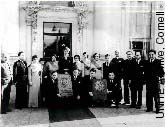
Delegation of Italian Dressmakers, Local 89, ILGWU, White House, 1934. (1)
Eleanor Roosevelt first learned about wages and working conditions as a young volunteer at the Rivington Street Settlement House on the lower east side of Manhattan at the turn of the twentieth century. She never forgot the lessons she learned there. In 1919, as a mother with young children, she volunteered as a French translator for the International Congress of Working Women in Washington, DC, where she met Rose Schneiderman, a capmaker, member of the International Ladies Garment Workers' Union, and president of the National Women's Trade Union League. ER joined the NWTUL in 1922 and introduced her husband to the world of trade union women.
At a White House ceremony on March 28, 1934, pictured above, Sister Margaret Di Maggio, a rank-and-file member of the ILGWU, presented a plaque to Mrs. Roosevelt, which read "To Eleanor Anna Roosevelt from her fellow workers of the Italian Dressmakers Local 89." According to Justice, the union paper, the First Lady "conversed amiably with others about trade union activities among the women, relating several interesting episodes revealing her own steadfast allegiance to the cause of labor and political liberty."
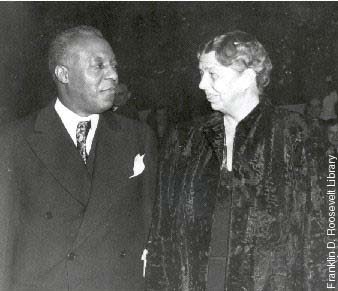
In 1936, ER began her syndicated column "My Day," appearing in over 50 newspapers nationwide. As an author and journalist she joined what is today The Newspaper Guild-CWA. Despite often vicious criticism, she reached out to garment workers, miners, electrical workers, migrants, and many others. Her commitment to labor issues intersected with her deep concern over racial segregation in her work with A. Philip Randolph and the Brotherhood of Sleeping Car Porters. Brother Randolph expressed his appreciation in the following letter. (3)
August 5, 1943
Mrs. Eleanor Roosevelt
WhiteHouse
Washington, D.C.
My dear Mrs. Roosevelt:
Just a word in these days of crisis and of storm
and stress
to express my deep appreciation for the great service you are
rendering in you own way to the cause of democracy in general,
and justice for the Negro people in particular. I need not
tell you that there is a deep affection among the Negro people
for you, because of your forthright and sincere advocacy in
human justice.
Because of your attitude for equality and freedom
for all
people you are the subject of severe criticism among certain
sources, but this has been so with the pioneers of human liberty.
I just wanted to send you this note, and I do
not expect
an answer.
Sincerely yours,
A. Philip Randolph
International President
APR:RB
To view all footnotes, click here.