The Eleanor Roosevelt Papers Project is a university-chartered research center associated with the Department of History of The George Washington University



Question: What New Deal Policies did Eleanor Roosevelt influence?
Answer:
 Although
she worried at first that her life as first lady would
end
her freedom to speak out and act for the causes she cared
so deeply about, ER soon found ways of exerting her influence
in her new role. She began holding press conferences open
only to women reporters. She worked successfully with
Molly Dewson to increase the number of women appointments
in the Roosevelt administration. She argued that women
should
be able to hold their jobs even if their husbands were
employed, and made sure there were relief programs for
women ("She-She-She
Camps"), as well as for men. She pressed for the creation
of youth programs, encouraging the establishment of the
National Youth Administration.
She befriended black leaders
Mary McLeod Bethune and Walter
White, became a champion of civil rights, lobbied
against the poll tax, supported the
Southern Tenant Farmer's Union, and pushed for the
inclusion of blacks in government programs. Housing became
one of
her special concerns and she worked with the Housing Division
of the Public Works Administration
and the
Washington Housing Authority to support planned communities
("greenbelt towns") and slum clearance projects. She enthusiastically
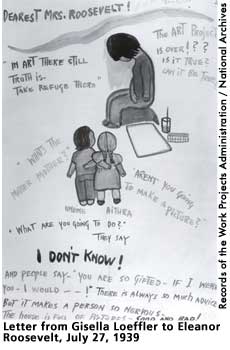
supported federal aid to the arts, played a key role
in
establishing the Federal
Arts Projects, and defended the projects against congressional
attacks. She took a special interest in the communities
built by the Roosevelt administration for displaced workers,
particularly the one at Arthurdale,
West Virginia, which she visited frequently. A strong
supporter of workers' rights, she lobbied for the
National Labor Relations Act, championed the concept
of a living wage, and urged the passage of the
Fair Labor Standards Act.
Although
she worried at first that her life as first lady would
end
her freedom to speak out and act for the causes she cared
so deeply about, ER soon found ways of exerting her influence
in her new role. She began holding press conferences open
only to women reporters. She worked successfully with
Molly Dewson to increase the number of women appointments
in the Roosevelt administration. She argued that women
should
be able to hold their jobs even if their husbands were
employed, and made sure there were relief programs for
women ("She-She-She
Camps"), as well as for men. She pressed for the creation
of youth programs, encouraging the establishment of the
National Youth Administration.
She befriended black leaders
Mary McLeod Bethune and Walter
White, became a champion of civil rights, lobbied
against the poll tax, supported the
Southern Tenant Farmer's Union, and pushed for the
inclusion of blacks in government programs. Housing became
one of
her special concerns and she worked with the Housing Division
of the Public Works Administration
and the
Washington Housing Authority to support planned communities
("greenbelt towns") and slum clearance projects. She enthusiastically
supported federal aid to the arts, played a key role
in
establishing the Federal
Arts Projects, and defended the projects against congressional
attacks. She took a special interest in the communities
built by the Roosevelt administration for displaced workers,
particularly the one at Arthurdale,
West Virginia, which she visited frequently. A strong
supporter of workers' rights, she lobbied for the
National Labor Relations Act, championed the concept
of a living wage, and urged the passage of the
Fair Labor Standards Act.
She visited coal mines, migrant camps, and the homes of sharecroppers and slum-dwellers. She inspected government programs and projects. Through her tireless travels throughout the country and the heavy volume of mail she received from people desperately seeking help, she placed herself more personally and directly in touch with the conditions under which people lived during the Depression than any member of FDR's administration. She employed this knowledge in her articles, speeches, radio talks, and the "My Day" column she began writing six days a week in 1936, urging the adoption of measures to address the needs of the American people. She sent some of the letters she received from people seeking help to government officials with a note asking if something could be done. She reported to FDR on conditions during the Depression, on the success or failure of New Deal programs, passed on letters asking for help, lobbied for specific policy initiatives, and urged him to act.
As Rexford Tugwell,
one of the original members of FDR's
Brains Trust, described ER's attempts to lobby FDR,
"No one who ever saw Eleanor Roosevelt sit down facing her
husband, and, holding his eye firmly, say to him, 'Franklin,
I think you should . . .' or, 'Franklin, surely you will
not . . .' will ever forget the experience. . . . It would
be impossible to say how often and to what extent American
governmental processes have been turned in new directions
because of her determination."(1)
Notes:
- Rexford Tugwell, "Remarks," Roosevelt Day Dinner Journal, Americans for Democratic Action, January 31, 1963.
Sources:
Black, Allida M. Casting Her Own Shadow: Eleanor Roosevelt and the Shaping of Postwar Liberalism. New York: Columbia University Press, 1996, 23-49.
Cook, Blanche Wiesen. Eleanor Roosevelt: Volume Two, The Defining Years, 1933-1938. New York: Penguin Books, 1999, 70-91, 130-189, 233-334, 389-434, 508-537.
Lash, Joseph P. Eleanor and Franklin. New York: W. W. Norton & Company, 1971, 366-433, 452-472, 511-554.