The Eleanor Roosevelt Papers Project is a university-chartered research center associated with the Department of History of The George Washington University



Question: How did ER help advance FDR's career after he contracted polio? What political and professional activities did she pursue?
Answer:
 From
1921 until 1928, while FDR
focused on his rehabilitation from polio, ER expanded her
political networks, honed her political skills, and transformed
herself into a nationally recognized political leader. Through
the 1920s, ER worked closely with the four most powerful
women's organizations in New York State: the Women's
Division of the Democratic State Committee, the League
of Women Voters, the Women's
Trade Union League and the Women's
City Club, a group that brought together leaders from
many activist organizations. Her work not only helped keep
her husband's name in the public eye and prepared the way
for his election as governor of New York, but also made
her one of New York's leading politicians in her own right.
From
1921 until 1928, while FDR
focused on his rehabilitation from polio, ER expanded her
political networks, honed her political skills, and transformed
herself into a nationally recognized political leader. Through
the 1920s, ER worked closely with the four most powerful
women's organizations in New York State: the Women's
Division of the Democratic State Committee, the League
of Women Voters, the Women's
Trade Union League and the Women's
City Club, a group that brought together leaders from
many activist organizations. Her work not only helped keep
her husband's name in the public eye and prepared the way
for his election as governor of New York, but also made
her one of New York's leading politicians in her own right.
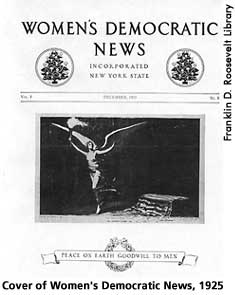
She helped lead the Women's Division of the State Democratic Party, a group the party created to organize women voters after they had achieved the right to vote in 1920. She edited and wrote articles and editorials for the Women's Democratic News and worked with Molly Dewson, Marion Dickerman, and Nancy Cook to establish women's Democratic clubs throughout the state. She became an effective public speaker after working with Louis Howe, FDR's political strategist, and soon engaged in debates across the state and a national lecture tour. In 1925, she delivered her first radio address and in 1927, she published her first article in the popular press, "What I Want Most Out of Life."
ER also chaired the League of Women Voters Legislative Affairs Committee and represented the League on the Women's Joint Legislative Committee. Each week, she studied the Congressional Record, examined legislation and committee reports, interviewed members of Congress and the State Assembly, and met with League officers to discuss the information she gathered. Each month, she assembled her analyses and presented a report for League members outlining the status of bills in which the organization was interested and suggested strategies by which it could achieve its legislative goals. ER also spoke out at these monthly assemblies on primary reform, voter registration, and party identification. Recognizing the extensive contributions she made, the League elected her its vice-chairman. By 1928, she had testified before the New York State Assembly in support of protective labor legislation for women and children, had convinced the state Democratic Party to appoint equal numbers of men and women to party committees, and testified before the state and national party platform committees.
ER's interest in foreign affairs also blossomed during the 1920s, preparing the groundwork for her contributions to human rights and international understanding after World War II. In 1923, with Esther Lape and Narcissa Vanderlip, she helped organize the Bok Peace Prize competition. In 1924, when the Senate Special Committee on Propaganda summoned Lape to testify, ER accompanied Lape to the hearing. ER also wrote editorials urging women to work to eliminate the causes of war, allied herself with the leaders of the Women's International League for Peace and Freedom, and, in 1927, hosted a conference of four hundred women in Hyde Park to organize a women's peace movement.
She brought enthusiasm, dedication, and a lively interest in other people to her work. She urged coworkers and fellow reformers to spend less time theorizing, set realistic goals, prioritize their tasks, and delegate assignments. Her persistent pragmatism attracted attention within the party and women's political organizations. Soon the media publicized her clout, treating her as an "influential woman who speaks her political mind."(1)
In addition to all of these political activities, ER began
teaching American history and literature at the Todhunter
School, a private girls school in Manhattan where her friend
Marion Dickerman taught and served as vice-principal. With her
Val-Kill partners, she began
Val-Kill Industries.