The Eleanor Roosevelt Papers Project is a university-chartered research center associated with the Department of History of The George Washington University



The Great Depression (1929-1939)
Although the United States had experienced several depressions before the stock market crash on October 27, 1929, none had been as severe nor as long lasting before "Black Thursday" struck Wall Street. At first, economists and leaders thought this was a mild bump, perhaps merely a correction of the market, or in any case, no worse than the recession the nation suffered after World War I.
 Numbers soon proved the optimists incorrect. The depression
steadily worsened. By spring of 1933, when FDR
took the oath of office, unemployment had risen from 8
to 15 million (roughly 1/3 of the non-farmer workforce)
and
the gross national product had decreased from $103.8 billion
to $55.7 billion. Forty percent of the farms in Mississippi
were on the auction block on FDR's inauguration day. Although
the depression was world wide, no other country except
Germany
reached so high a percentage of unemployed. The poor were
hit the hardest. By 1932, Harlem had an unemployment rate
of 50 percent and property owned or managed by blacks fell
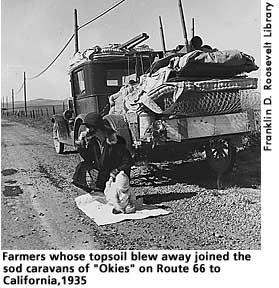
from 30 percent to 5 percent in 1935. Farmers in the Midwest
were doubly hit by economic downturns and the Dust Bowl.
Schools, with budgets shrinking, shortened both the school
day and the school year.
Numbers soon proved the optimists incorrect. The depression
steadily worsened. By spring of 1933, when FDR
took the oath of office, unemployment had risen from 8
to 15 million (roughly 1/3 of the non-farmer workforce)
and
the gross national product had decreased from $103.8 billion
to $55.7 billion. Forty percent of the farms in Mississippi
were on the auction block on FDR's inauguration day. Although
the depression was world wide, no other country except
Germany
reached so high a percentage of unemployed. The poor were
hit the hardest. By 1932, Harlem had an unemployment rate
of 50 percent and property owned or managed by blacks fell
from 30 percent to 5 percent in 1935. Farmers in the Midwest
were doubly hit by economic downturns and the Dust Bowl.
Schools, with budgets shrinking, shortened both the school
day and the school year.
The breadth and depth of the crisis made it the Great Depression.
![[picture: Makeshift housing in New York City ]](../images/fdrl_hooverville.jpg) No one knew how best to respond to the crisis. President
Hoover believed the dole would do more harm than good and
that local governments and private charities should provide
relief to the unemployed and homeless. By 1931, some states
began to offer aid to local communities. FDR,
then governor of New York, worked with Harry
Hopkins and Frances Perkins
to begin a direct work relief program. This helped only
a very few. By 1932, only 1/4 of unemployed families received
any relief. In 1932, only 1.5 percent of all government
funds were spent on relief and averaged about $1.67 per
citizen. Cities, which had to bear the brunt of the relief
efforts, teetered on the edge of bankruptcy. By 1932, Cook
County (Chicago) was firing firemen, police, and teachers
(who had not been paid in 8 months). Breadlines and Hoovervilles
(homeless encampments) appeared across the nation.
No one knew how best to respond to the crisis. President
Hoover believed the dole would do more harm than good and
that local governments and private charities should provide
relief to the unemployed and homeless. By 1931, some states
began to offer aid to local communities. FDR,
then governor of New York, worked with Harry
Hopkins and Frances Perkins
to begin a direct work relief program. This helped only
a very few. By 1932, only 1/4 of unemployed families received
any relief. In 1932, only 1.5 percent of all government
funds were spent on relief and averaged about $1.67 per
citizen. Cities, which had to bear the brunt of the relief
efforts, teetered on the edge of bankruptcy. By 1932, Cook
County (Chicago) was firing firemen, police, and teachers
(who had not been paid in 8 months). Breadlines and Hoovervilles
(homeless encampments) appeared across the nation.
![[picture: destitute man leaning against vacant store, 1935]](../images/fdrl_27-0621a.jpg) Those hurt the most were more stunned than angry. Many sank
into despair and shame after they could not find jobs. The
suicide rates increased from 14 to 17 per 100,000. Protest
that did occur was local, not national: "farm holidays,"
neighbors of foreclosed farmers refusing to bid on farms
at auction, neighbors moving evicted tenants' furniture
back in, and local hunger marches.
Those hurt the most were more stunned than angry. Many sank
into despair and shame after they could not find jobs. The
suicide rates increased from 14 to 17 per 100,000. Protest
that did occur was local, not national: "farm holidays,"
neighbors of foreclosed farmers refusing to bid on farms
at auction, neighbors moving evicted tenants' furniture
back in, and local hunger marches.
Resistance to protest often turned violent. In 1932, four members of the Dearborn hunger march were shot and killed when 1,000 soldiers accompanied by tanks and machine guns evicted veterans living in the Bonus Army camp in Washington, D.C.
FDR, after assuming the presidency, promoted a wide variety
of federally funded programs aimed at restoring the American
economy, helping relieve the suffering of the unemployed,
and reforming the system so that such a severe crisis could
never happen again. However, while the New Deal did help
restore the GNP to its 1929 level and did introduce basic
banking and welfare reforms, FDR refused to run up the deficits
that ending the depression required. Only when the federal
government imposed rationing, recruited 6 million defense
workers (including women and African Americans), drafted
6 million soldiers, and ran massive deficits to fight World
War II did the Great Depression finally end.
Sources:
Leuchtenburg, William E. Franklin D. Roosevelt and the New Deal, 1932-1940. New York: Harper Torchbooks, 1963, passim.
McElvaine, Robert S. The Great Depression: America,
1929-1941.
New York: Times Books, 1993, passim.
For more information on the Great Depression, visit the following web sites:
-
America from the Great Depression to World War II
: Photographs from the Farm Security Administration and
the Office of War Information.
-
The Franklin D. Roosevelt Presidential Library :
An extensive collection of digitized documents, photographs,
and biographies.
-
The Great Depression : An overview prepared by the
archivists of the FDR Presidential Library.
- The
New Deal Network : An award winning web site of
documents, photographs, lesson plans, and listserves
relating to
the Great Depression and the New Deal.
-
We Made Do: Recalling the Great Depression. An on-going
project of Mooresville High School students containing
oral histories, period photographs and e-mailed contributions
of viewers who have taken time to share their memories.
- The 1930s : An extensive overview of the decade by Gilder Lehrman historyonline.