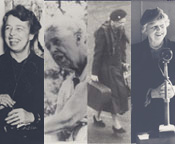
The Eleanor Roosevelt Papers Project is a university-chartered research center associated with the Department of History of The George Washington University


Fair Labor Standards Act
Since 1912, Eleanor Roosevelt and other social reformers rallied for the passage of legislation establishing a minimum wage and a forty-hour work week, as well as the abolishment of child labor. ER's service on New York's Factory Investigation Commission, which was established after the Triangle Shirtwaist Company fire in 1911, contributed to her knowledge of and dedication to labor reform. ER also testified before state committees on the matter of protective labor legislation during the time FDR was governor of New York
During the second half of the 1930s, FDR struggled to continue
to pass his New Deal legislation. This difficulty can be
attributed to growing conservative opposition, as well as
the regional and sectional tensions of the Democratic party.
Nevertheless, in 1938 the Fair Labor Standards Act, which
contained many of ER's labor concerns passed through the
Congress. The Act prohibited child labor and required industry
to adopt in stages a forty-cent hourly minimum wage, as
well as established a forty-hour work week. The act did
exempt the agriculture industry, domestic service, and certain
other service categories. The FLSA ended up being the last
piece of New Deal legislation passed.
Sources:
Beasley, Maurine, Holly C. Schulman and Henry R. Beasley, eds. The Eleanor Roosevelt Encyclopedia. Westport, Conn.: Greenwood Press, 2001, 295.
Black, Allida. Casting Her Own Shadow: Eleanor Roosevelt and the Shaping of Postwar Liberalism. New York: Columbia University Press, 1996, 18.
Cook, Blanche Wiesen. Eleanor Roosevelt: Volume Two, 1933-1938. New York: Viking Press, 1999, 266, 515-16.
Kennedy, David. Freedom From Fear: The American People
in Depression and War, 1929-1945. New York: Oxford
University Press, 1999, 344-6
For more information on the Fair Labor Standards Act, visit the following web site: