The Eleanor Roosevelt Papers Project is a university-chartered research center associated with the Department of History of The George Washington University



American Association for the United Nations
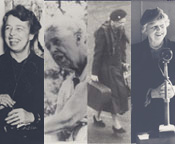
![[picture: Members of the American Association for the United Nations on tour of the UN, 1952]](../images/un_aaun.jpg) The
United Nations Association was founded
in 1943 and then renamed the American Association for
the United
Nations (AAUN) in 1945. As an organization, the AAUN had
two central goals: to educate the public about the United
Nations
system and to encourage the active participation of the
United States at the United Nations. Eleanor Roosevelt
was involved
with the AAUN from its inception in 1943 and officially
joined its Board of Directors in December 1947. While
an official member
of the United States delegation, ER did much to advance
the work of the AAUN. She felt strongly that the UN was
the single
best way to avoid war in the future, but she was also keenly
aware that if Americans did not understand the United
Nations
system they were likely to oppose it.
The
United Nations Association was founded
in 1943 and then renamed the American Association for
the United
Nations (AAUN) in 1945. As an organization, the AAUN had
two central goals: to educate the public about the United
Nations
system and to encourage the active participation of the
United States at the United Nations. Eleanor Roosevelt
was involved
with the AAUN from its inception in 1943 and officially
joined its Board of Directors in December 1947. While
an official member
of the United States delegation, ER did much to advance
the work of the AAUN. She felt strongly that the UN was
the single
best way to avoid war in the future, but she was also keenly
aware that if Americans did not understand the United
Nations
system they were likely to oppose it.
ER's take on the situation was later proven correct when,
in the early 1950s, the UN suffered a decline in support
among the American public, largely because most Americans
did not understand the organization's function. Consequently,
ER lent her name and presence to many of the AAUN's fundraising
efforts, donated a sizable amount of money to the organization
from her own pocket, and spoke and sent correspondence on
its behalf. One of the most valuable services she performed
for the AAUN was in registering new members. As a prestigious
UN delegate and former first lady, ER had the ability to
draw a crowd, and she often used her popularity to encourage
people to join the AAUN. In 1948, ER even took the unprecedented
step of joining with the AAUN to support its platform on
the Middle East even though she was a sitting member of
the United States delegation. Immediately following her
departure from the State Department in January 1953, ER
deepened her involvement with the AAUN. As a full-time volunteer,
she quickly became its single most important spokesperson
in lecture tours that took her throughout the United States
and around the world. In 1964, the American Association
for the United Nations merged with the U.S. Committee for
the United Nations to create a new organization known as
the United Nations Association of the United States of America.
That organization continues to exist to the present day,
retaining largely the same mission that it had at its founding.
Sources:
"About UNA: Overview." United Nations Association of the United States. Internet on-line. Available From http://www.unausa.org/aboutus/index.asp.
Beasley, Maurine H., Holly C. Shulman, and Henry R. Beasley, eds. The Eleanor Roosevelt Encyclopedia. Westport, Conn.: Greenwood Press, 2001, 7-8.
Lash, Joseph. Eleanor, The Years Alone. New York: W.W. Norton & Company, 1972, 128-129, 168, 233, 236.