The Eleanor Roosevelt Papers Project is a university-chartered research center associated with the Department of History of The George Washington University


Human Rights Timeline:
From European Expansion to the Enlightenment
1450-1500 CE
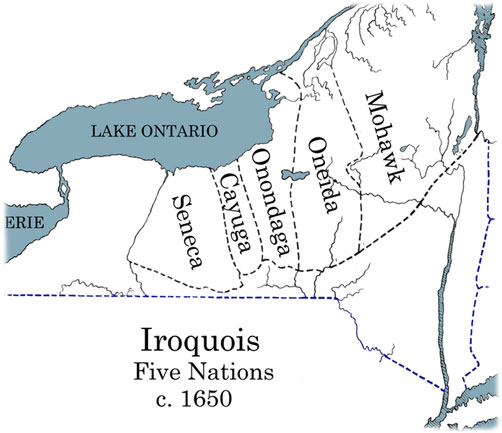 Map of Iroquois Confederacy
The Iroquois Constitution is created, forming a confederacy of five independent American nations: Mohawk, Onondaga, Seneca, Oneida, and Cayuga (the Tuscarora nation is added around 1715 to the confederacy). The constitution establishes a democratic government with rights and responsibilities of elected officials, a system for the creation of laws and arbitration of disputes between nations, a religion with a belief in a creator, laws governing birth, adoption, and death/funeral rights, rights of foreign nations, and a process for declaring and conducting war. The Iroquois Constitution becomes one of the influential documents in the creation of the U.S. Constitution. 1500-1550 CEConquistadors embark on expeditions to Central and South America, which lead to the conquest of the Aztec and Inca civilizations. 1583-1645 CE
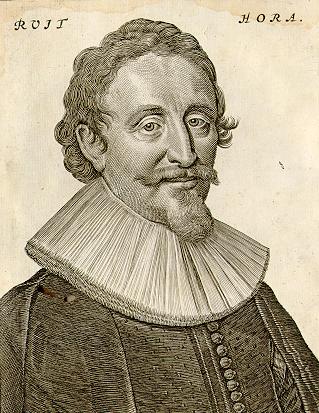 Hugo Grotius from 1607 text
Hugo Grotius, a Dutch jurist credited with the birth of international law, speaks of the brotherhood of humankind and the need to treat all people fairly. 1628 CE
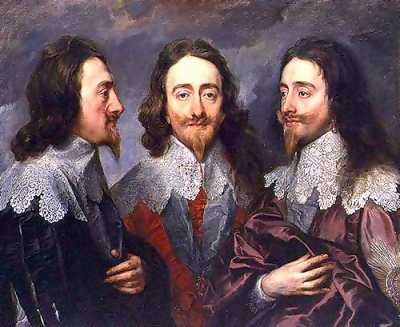 Charles III, 1636 by Anthony van Dyck
The British Parliament refuses to approve new taxes until King Charles I signs the British Petition of Right. The petition prohibits the monarch from arresting people on an arbitrary basis and from housing troops in private homes without owners' consent. 1648 CE
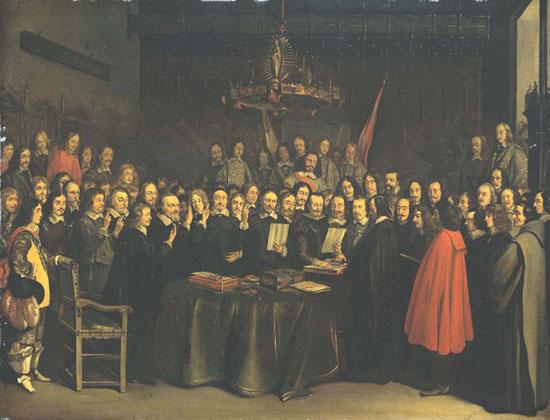 The Ratification of the Treaty of Westphalia, by Gerard Terborch
The Treaty of Westphalia ends the Thirty Years' War. The treaty provides a basis for greater religious tolerance in the international sphere and establishes national sovereignty. 1679 CEThe Habeas Corpus Act in Britain gives anyone who is detained the right to a fair trial within a certain amount of time. 1688-1689 CEThe British Parliament offers the crown to Prince William of Orange who takes power in a bloodless revolution. The Glorious Revolution represented the destruction of divine-right monarchy and asserted the supremacy of the Parliament. 1689 CE
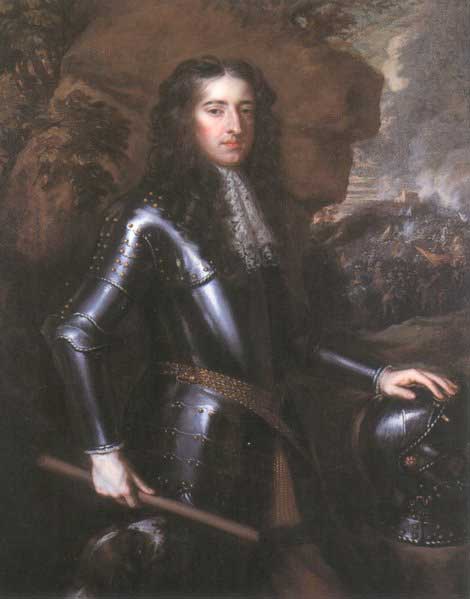 William of Orange, by Peter Lely
Before William of Orange is allowed to take the throne, Parliament makes him sign the British Bill of Rights. The Bill guarantees the Parliament's right to petition the king and to bear arms. In addition, it prohibits excessive fines and bail as well as cruel and unusual punishment for Parliamentarians. 1690 CEJohn Locke writes about the notions of natural rights of life, liberty and property in his Two Treatises on Government. 18th Century CEThe Enlightenment sweeps across Europe. Philosophers triumph reason and the belief that human beings have the ability to create better societies for themselves. 1748 CE
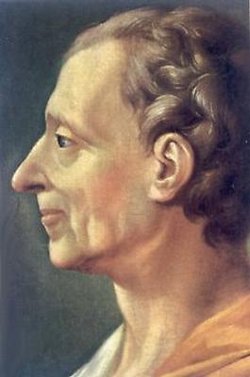 Portrait of Montesquieu in 1728
Charles de Secondat, Baron de Montesquieu writes Spirit of the Laws in which he sets forth the theory of three branches of government: executive, legislative and judicial. Montesquieu argues that despotism can be avoided if political power is divided with checks on power. 1762 CEJean-Jacques Rousseau writes The Social Contract in which he argues that the "general will," reflecting the common interests of all people in a nation, is sacred and absolute. |