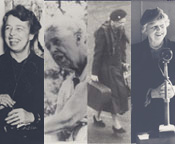
The Eleanor Roosevelt Papers Project is a university-chartered research center associated with the Department of History of The George Washington University

About The Project: Overview
More than any woman of the twentieth century, Eleanor Roosevelt inspired citizens and nations “to hazard all they have” to build a world governed by diplomacy, citizen engagement, and democratic policy. Her example of peace building and human rights advocacy throughout her life is a model to be studied and applied not only here in the United States but around the world.
As she moved from first lady to diplomat to citizen activist, she not only became the most ardent champion of human rights, but also one of the century’s most prolific journalists --publishing more than 8,000 columns, 580 articles, 27 books, 100,000 letters, delivering over 1000 speeches, and appearing on more than 300 radio and television shows.
Yet, her voice has been silenced, her vision and influence shrouded in stereotype or confined to obscure footnotes.
Since 2000, The Eleanor Roosevelt Project has worked to return ER’s voice back into the written record and uses this rich history’s contributions to train approximately 6,000 teachers, 500 civil society leaders, 100 policymakers, and countless citizens around the world to study and apply her writings, knowledge and strategy in their various arenas.
Eleanor Roosevelt did not confine her public outreach to the written word alone. Instead, she relied upon a wide range of media technologies to reach the broadest audience possible—a standard that we seek to emulate at the Eleanor Roosevelt Project. We have developed:
- critically praised multi-media documentary editions reproducing ER’s voice and the points her contemporaries raised as she debated how best to rebuild a world from the horrors of war;
- exhibits for historic sites and international agencies;
- curricula and multi-media teaching aids accessible to all with Internet access;
- human rights training programs for civil society leaders, legislators at home and abroad, and congressional fellows; and
- mentoring programs for students of all ages.
In short, we make rigorous, important scholarship available and useful to an increasingly diverse and ever-expanding audience.
A brief history: Founded in 2000, with strong support from the National Archives, the National Endowment for the Humanities, the George Washington University, a host of private donors, and an advisory board chaired by Hillary Rodham Clinton and Arthur Schlesinger, Jr., the project took a traditional path to publication – focusing only on producing digital and print publications that preserved and documented Eleanor Roosevelt’s influence on American politics and diplomacy.
Documentary editions: Papers document Eleanor Roosevelt’s life and political career. Comprising millions of pages of records stored in libraries and archives in all fifty states, and throughout the world, The Eleanor Roosevelt Project selects the material that most genuinely reflects her work and makes it available to everyone through the digital and print publication of five volumes that reproduce her most historically significant writings, and provides readers with all the background information they need to understand and interpret it for themselves.
Much more than a compilation of writings, these documentary editions enliven the use of historical documents in the classroom and make Eleanor Roosevelt’s rich contribution to the history of politics, government, and human rights relevant to a new generation of learners, scholars, and policy makers. The first volume received rave reviews in both Newsweek and the academic press. Indeed Archivist Allen Weinstein described our work as “magnificent” and told the Senate Judiciary Committee that the Project “set the standard all projects should try to emulate.”
When the Project realized that its initial focus on traditional scholarly media did not meet the growing, widespread demand this material generated, it then quickly moved to make this material available in a variety of forms to satisfy its diverse constituency.
Eleanor Roosevelt on the Internet: These efforts bore fruit in three highly-used, Web-based projects the Eleanor Roosevelt Project developed: an electronic “mini-edition” of ER’s correspondence with John F. Kennedy during the election of 1960; a Web curriculum entitled “Teaching Eleanor Roosevelt” that the National Park Service uses to interpret the Eleanor Roosevelt National Historic Site at Val-Kill; and the online publication of all 8,112 My Day columns that ER wrote in her 26 years as a nationally syndicated columnist. These sites (www.gwu.edu/~erpapers) receive roughly 1.2 million hits a year.
Curricula and teaching aids: Since launching Eleanor Roosevelt on the Web, our focus expanded to take greater account of the significant audio-visual record that ER left behind and for which the Internet furnishes an ideal means of communication. Few people know that in the aftermath of Japan’s attack on Pearl Harbor, ER addressed the nation before her husband did—an event that the Project highlights in a film produced for students, teachers, and the general public.
Reaction to these materials has been strong. It has inspired teachers to create their own summer institutes tied to the material. For example, the Summer Institute for the Study of Genocide and Human Rights and fifteen school districts (across ten states) use this material as the basis for teacher in-service programs.
This demand deepened the Project’s commitment to multimedia outreach still further. Plans for the future include an annotated electronic edition of ER’s postwar writings, an online exhibition that showcases ER’s various incarnations as teacher, journalist, party leader, first lady, and diplomat. In addition, a film documenting her political career, tentatively entitled “The Courage to Lead” will be available. Funds are crucial necessary to support these endeavors. As resources grow, The Eleanor Roosevelt Project will make this material available to a global audience in audio, video, and printed form.
Exhibitions for historic sites and international agencies: Working in close collaboration with noted exhibit designers, the Project curated major exhibits on Eleanor Roosevelt and/or the Universal Declaration of Human Rights for the United Nations, the Franklin D. Roosevelt Presidential Library and Museum, the Eleanor Roosevelt National Historic Site, and the Washington National Cathedral. Current exhibit projects include the Four Freedoms National Park on Roosevelt Island and the new permanent exhibit for the Franklin D. Roosevelt Library and Museum.
Human rights training programs: As word of the Project’s work on the Universal Declaration of Human Rights spreads, diplomatic and civil society sectors request our services. The State Department asked the Director to conduct Web-chats on the Universal Declaration of Human Rights and to lead human rights trainings in Albania, Argentina, Brazil, Geneva and Macedonia. The Fulbright, Humphrey, and Meridian House International Fellowship Programs asked Project staff to present Eleanor Roosevelt’s activism and her work drafting the Universal Declaration of Human Rights to more than 500 visiting journalists and civil society leaders. The People-to-People international exchange program invited the Director to join its delegation to China where she presented the Project’s human rights curricula to twenty teachers in Beijing.
Most important, the Project designed an international mentoring summit, which met in Geneva, and included women’s human rights leaders from fifty nations, the State Department, the Office of the High Commissioner for Human Rights, the International Labour Organization, and more than 100 women representing governments and civil society organizations.
Mentoring students of all ages: The project could not undertake this innovative outreach if we did not have a core of dedicated, engaged students to support our work. In addition to our core of more than 130 George Washington University students , more than twenty students from fifteen other universities have travelled to Washington to work alongside us. Emboldened by the work, they have not only incorporated this record into their own studies but taken it back out into the world in their own work with organizations that include the Clinton Global Initiative, the Human Rights Campaign, New York Lawyers for the Public Interest, the Peace Corps, the State Department, Water.Org, and other non-governmental organizations.
In short, the Eleanor Roosevelt Project is as innovative and multi-faceted as the woman whose work it preserves and presents. It conducts rigorous scholarly analysis, edits highly-praised, precedent-redefining editions, leads workshops and trainings, and makes this material accessible to the world in ways that inspire diverse communities to act, negotiate, and lead.
All donations are tax-exempt as the Eleanor Roosevelt Project is a Chartered Research Center of the George Washington University. In addition to the University, its major supporters include the National Archives and Records Administration, the National Endowment for the Humanities, and a host of private donors and foundations. All donations should be made payable to The Eleanor Roosevelt Project/George Washington University.The project offices are located in the fourth floor of Old Main Building on the Foggy Bottom Campus of the George Washington University, 1922 F Street, NW. Staff may be reached by phone (202-994-3000), email (erpapers@gwu.edu) and fax (202-994-3043).