The Eleanor Roosevelt Papers Project is a university-chartered research center associated with the Department of History of The George Washington University

Eleanor Roosevelt: 1946-1952
| 1946 |
|
| 1947 | ![[Image from ER's FBI Files]](images/erfbifiles_subversive_t.jpg) Chairs 18-nation UN Human Rights Commission charged with drafting a declaration of human rights Chairs 18-nation UN Human Rights Commission charged with drafting a declaration of human rightsSpearheads the creation of Americans for Democratic Action Refuses to accept NAACP petition to UN Opposes Truman Doctrine for operating outside the UN Supports Marshall Plan Supports India which, under Gandhi's leadership, wins independence from Britain Criticizes Truman for requiring loyalty oaths for government employees Shifts from supporting trusteeship to endorsing separate Jewish state Rebukes Henry Wallace and the Progressive Citizens of America Writes "The Russians Are Tough," and "Should a Negro Boy Ask a White Girl to Dance?" |
| 1948 | ![[photo: ER with Harry S Truman and Walter White, Washington DC, 1947]](images/er_hst_ww1948_t.jpg) Delivers lecture,"The Struggles for the Rights of Man," at the Sorbonne Delivers lecture,"The Struggles for the Rights of Man," at the SorbonneOpposes Mundt-Nixon Bill Address NAACP annual convention from steps of Lincoln Memorial War erupts in Palestine; threatens resigning from UN to pressure Truman to recognize Jewish homeland Mao defeats Chiang Kai-Shek and China becomes a communist nation Korean War begins Disagrees with State Department policy toward Russia Reluctantly endorses Truman for re-election Presents Universal Declaration of Human Rights to General Assembly for adoption Begins ABC radio program Writes "Liberals in This Year of Decision.," "Plain Talk about Wallace," and "The Promise of Human Rights." |
| 1949 | ![[photo: ER with Larence Spivak and Martha Roundtree in 'Meet the Press']](images/er_meetthepress1949_t.jpg) Debates Cardinal Spellman over federal aid to parochial schools Debates Cardinal Spellman over federal aid to parochial schoolsAppears on "Meet the Press" Criticizes Taft-Hartley restrictions Writes This I Remember, the second volume of her autobiography, and "Making Human Rights Come Alive." |
| 1950 | ![[photo: ER with Helen Gahagan Douglas]](images/er_hgdouglas_t.jpg) Opposes Dennis v. United States; supports free speech Opposes Dennis v. United States; supports free speechCampaigns for Helen Gahagan Douglas in her unsuccessful Senate campaign against Richard Nixon Begins NBC radio show Refuses to appear as character witness for Alger Hiss, but is not convinced he is a spy Writes (with Helen Ferris) Partners: The United Nations and Youth, and "If I Were a Republican Today." |
| 1951 | ![[Image from ER's FBI files]](images/er_fbifiles_totalitarian1950_t.jpg) Opposes McCarthy; decries "politics of fear" Opposes McCarthy; decries "politics of fear"Leads US delegation to General Assembly meeting in Paris Conducts weekly broadcast for "Voice of America" in French to the French (later also broadcasts in German, Spanish and Italian) Writes "The Seven People Who Shaped My Life" and the foreword to Helen Keller's The Story of My Life |
| 1952 | 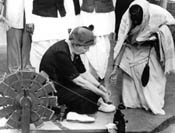 Defends The Nation when McCarthyites threaten censorship Defends The Nation when McCarthyites threaten censorshipCriticizes Eisenhower for not defending George Marshall from attacks by McCarthy Supports Stevenson in his presidential bid against Eisenhower Addresses 1952 Democratic convention on the UN Visits Lebanon, Syria and Jordan and meets with displaced Palestinians; travels to Israel and Pakistan; spends a month in India meeting with Nehru, then visits Nepal, Indonesia and the Phillippines to study democratic development in Asia Heads US delegation to inauguration of Chilean President Carlos Ibanez; meets with Chilean protestors and rebels Speaks to UN on political rights of women Reluctantly resigns from the UN delegation after Eisenhower wins election Writes the forewords to Beauty Behind Barbed Wire: The Arts of the Japanese in Our War Relocation Camps by Allen H. Eaton, A Fair World for All: The Meaning of the Declaration of Human Rights by Dorothy Canfield Fisher, and To Win These Rights: A Personal Story of the CIO in the South by Lucy Randolph Mason. Writes the Introduction to The Diary of a Young Girl by Anne Frank. |
![[photo: ER at the United Nations, 1947]](images/er_un1947_t.jpg) Pushes Truman to
Pushes Truman to